Photos courtesy of Casey Schmidt Ahl
A recent consumer report from Proven Winners showed the plant shoppers across IGCs, big-box stores and other vendors list quality and selection as their top priorities.
Independent garden centers have long boasted these qualities as our strengths compared to the competition. In fact, if you asked me a few years ago, what set us at Colonial Gardens apart from big-box competitors, those would be on the top of my list, followed by customer service.
That being said, these attributes are not a given at IGCs, especially when you have staff turnover. After losing two of our long-time employees in our annual and perennial departments, we faced several years of turnover.
Suddenly, the care of these plants had to be taught to folks with little experience. The immense selection we offered as a strength seemed an overwhelming task for new employees to master and recommend to customers. These seemingly inherent traits of our store were actually fully dependent on the staff manning the areas.
By 2024, I finally felt like we had a solid team of committed, enthusiastic employees staffed in that department. Like the years prior, the first year of employment involved getting the team on the same page about proper care for annuals in a retail nursery setting and understanding basic operations of our business as the seasons changed.
I could once again list “quality” as a virtue that I didn’t have to micromanage. However, building expertise outside of “reading the tag” or taking a class still felt out of reach. You can have the most dedicated employee who researches plant trials and new varieties and asks the advice of more experienced employees and growers, and their knowledge base will still rely on the reports of someone else’s experience, not their own.
The answer to addressing this problem, along with some other existing hurdles, came to me at a lunch and learn with Proven Winners in the fall of 2024 hosted by Quality Greenhouses. As the presenters worked through slides of display gardens and plant trials, I realized that these gorgeous gardens could be the solution to multiple challenges at our store.
Inspired by this session, I decided to try having our new staff design “test” gardens on our grounds for 2025.
Addressing existing challenges
Whether you call them “test,” “trial” or “display” gardens, all of them are similar in function, and for the purposes of this project, I think any of those descriptors could be appropriate.
Although we weren’t running a “trial” garden that involved breeder submissions and rankings, we were “trialing” or testing our plants for our conditions at the store. Keeping an element of aesthetic display was also important to address several challenges I had identified, as outlined below.
Challenge 1: Employees have limited experience with plant varieties and design.
Our employees were mostly working off their limited experience or recommendations from other staff, but they didn’t have the confidence that comes from years of hands-on growing experience.
Existing resources from growers will always paint their plants in the rosiest light — which is not necessarily reflective about how they perform in specific locations. Several of our staff did not have yards at home, let alone the energy to plant and care for gardens at home to gain that experience. They had trouble recommending combinations of plants, as they had not seen how the plants interacted together.
Challenge 2: Property edges need to be maintained but are often an afterthought.
We were putting labor and inventory into our planting beds, but without intention, leading to lackluster results. When sales slowed in late June, our Plant Care Team helped plant the edges of our garden center in preparation for our events in the second half of the year.
The plants were typically the leftovers, pot-bound and ragged, and were started so late that they did not develop well through the summer. It wasn’t necessarily a glowing reflection of our plant design and care skills.
Picking through the leftovers also didn’t allow for tailoring our choices to the specific challenges of the area, including browsing by deer and rabbits — as many beheaded begonias through the years could attest to.
While we are a destination for our events, we wanted to expand our “destination” status through the summer with a beautiful shopping experience.
Challenge 3: We have a lack of marketing content available for many plant varieties.
The internet is a landscape built on visuals. While Proven Winners has an extensive library of real-life photos of their plants, many growers do not. The pictures of plants on our greenhouse benches serve some function, but customers want to know what the plants look like at their peak.
On top of that, we are always looking for more content for our website and social media. Without our own photos, we were always looking for permission or lacking visuals while relying on grower and third-person accounts of how plants perform.
Setting parameters
I pitched the idea and was met with a perennial concern: profitability. How does this project make us money, and just as importantly, how can we make sure it doesn’t become a labor sink and lose us money?
While the outcome of this project would not have an obvious, measurable ROI, I felt strongly that it would be a benefit to our employees and the garden center as a whole. To help control the variables, I set up some guidelines for the trial gardens.
First, the garden beds were beds that we already cared for, even if it was mostly weeding or planting a handful of annuals. While there would be more labor in the initial phase of the project, it wouldn’t be much more than what currently existed.
Second, the project would not be renewed if other parts of employees' jobs were neglected. Helping customers, caring for retail plants and keeping the store clean and safe came first. No staff should be hiding in their test bed when there were customers in need of assistance.
Third, we focused on annuals so that we had the longest season of color and the ability to start over every year.
Fourth, all plans were approved by me. While our staff had a wide berth for how they wanted to approach the project, I had final say over the design and the budget. I asked each team member to select a theme for their bed and pitch a design. I would then order the plants proactively for the project.
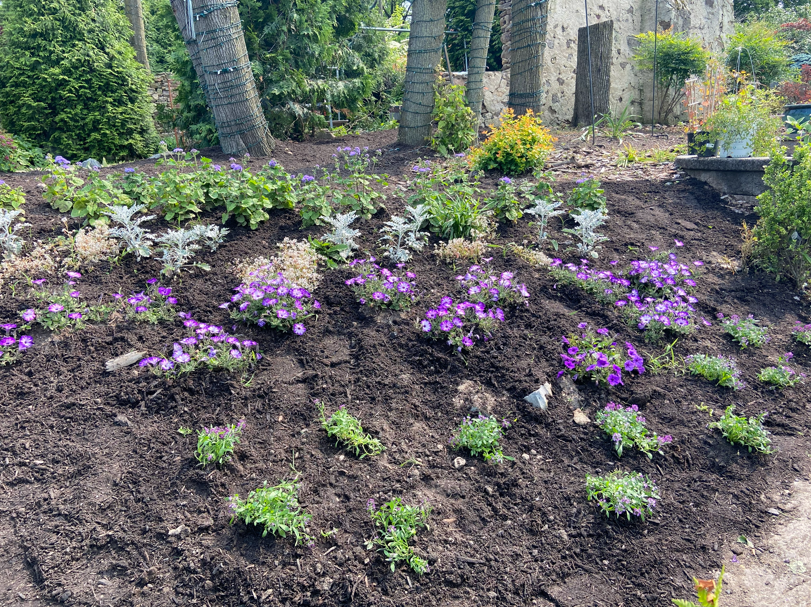
Each team member approached the “theme” idea differently. I picked a monochromatic blue-themed garden that included Ageratum, Dusty Miller, Blue Tiara Supertunias and Euphorbia.
Pat Davis picked a tropical vibe with drought-tolerant plants such as Portulaca, Salvia and Melampodium.
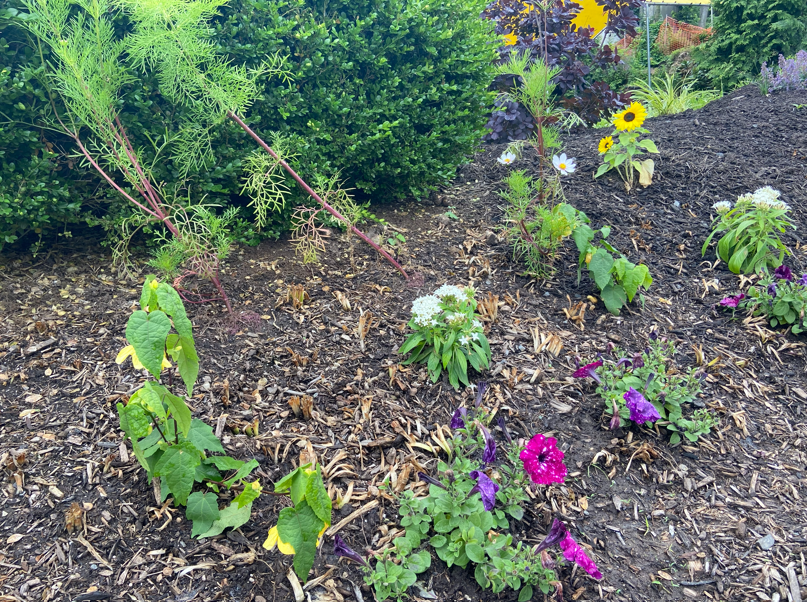
Lindsay Friedenberg leaned more conceptual, picking a cosmic theme with cosmos, sunflowers and Night Sky Petunias.
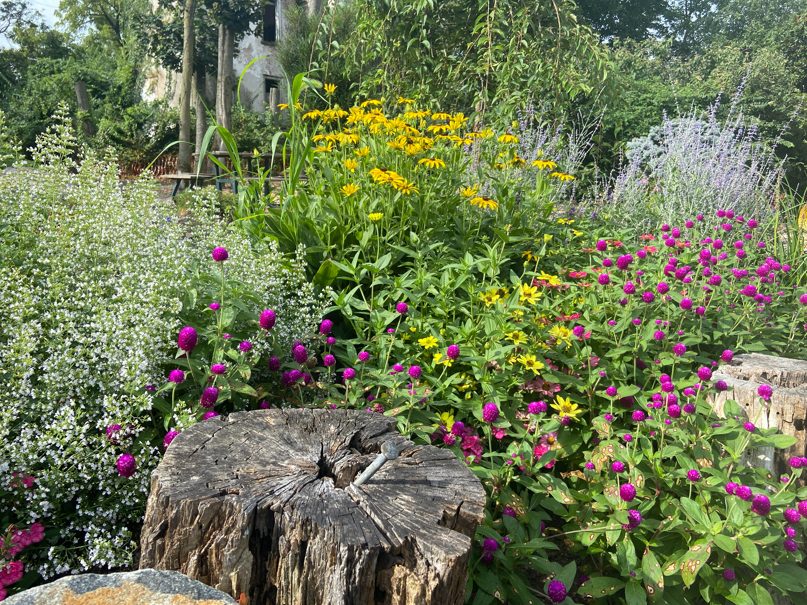
Ashley Ermold took direction from one of our landscape designers, Zach Yodis, to add whimsical annuals to his existing bed. She chose Gomphrena, zinnias, Salvia and Nicotiana.
Installation and results
These beds were installed in early June, when the season had slowed down enough to accommodate the projects. Throughout the summer, the staff occasionally fertilized and weeded their beds, but they mostly just kept up with the watering when necessary.
The beds matured and lasted into September and October, giving us a good sample of how these beds performed, even with pressure from deer, rabbits and summer heat.
The team talked about how each plant performed in different times of year in comparison to the plants around them and as a complement to the surrounding landscape. Of course, the most important results were not how the individual plants performed, but whether we successfully tackled the challenges we sought to address.
Result 1: Our employees broadened their knowledge of plants, learning from the successes and disappointments in their garden beds. Employees reported enjoying the project and feeling proud of their gardens.
With a season of growing experience under their belt, staff members have plants that they can whole-heartedly recommend to new gardeners.
The unassuming Melampodium can now be plopped into a customer's cart with the promise of a tidy globe of summer blooms.
Night Sky Petunias are beautiful but can easily be overwhelmed by other plants in the bed.
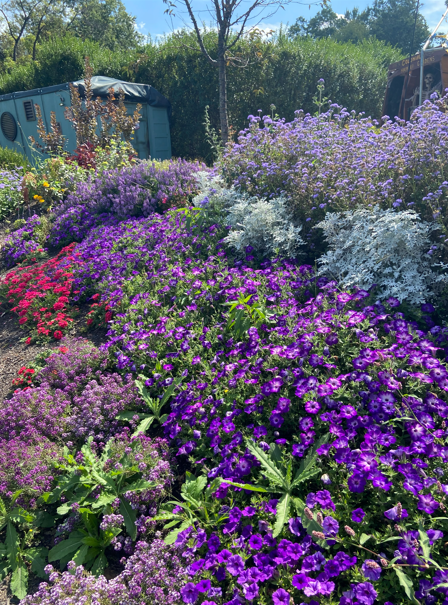
Yes, the Supertunias are absolutely worth the extra dollar when you want a lot of bang for your buck and don’t want to fuss over dead-heading in the summer heat.
Monarchs will flock to your Blue Horizon Ageratum.
Even our staff who didn’t participate in the project mentioned plants that they planned to recommend next year.
ROI could be measured by an increase in sales of the varieties used by the team, an increase in planting jobs landed or by employee feedback in confidence levels.
Result 2: Beds were filled out by the end of the summer, and customers complimented us on the beauty of the grounds.
Instead of pouring effort into getting plants established in July, the annuals required much less care by the time we were stretched for watering. By the time we hit our annual Butterfly Festival in August, the beds could be their own attractions, with monarchs, swallowtails and hummingbirds visiting the flowers.
A few customers asked what flowers were in the beds for their own gardens. One couple looked at them, mentioned how happy visiting our store made them and compared us to our local botanical garden.
Result 3: I gained plenty of material for social media, YouTube videos and blogs.
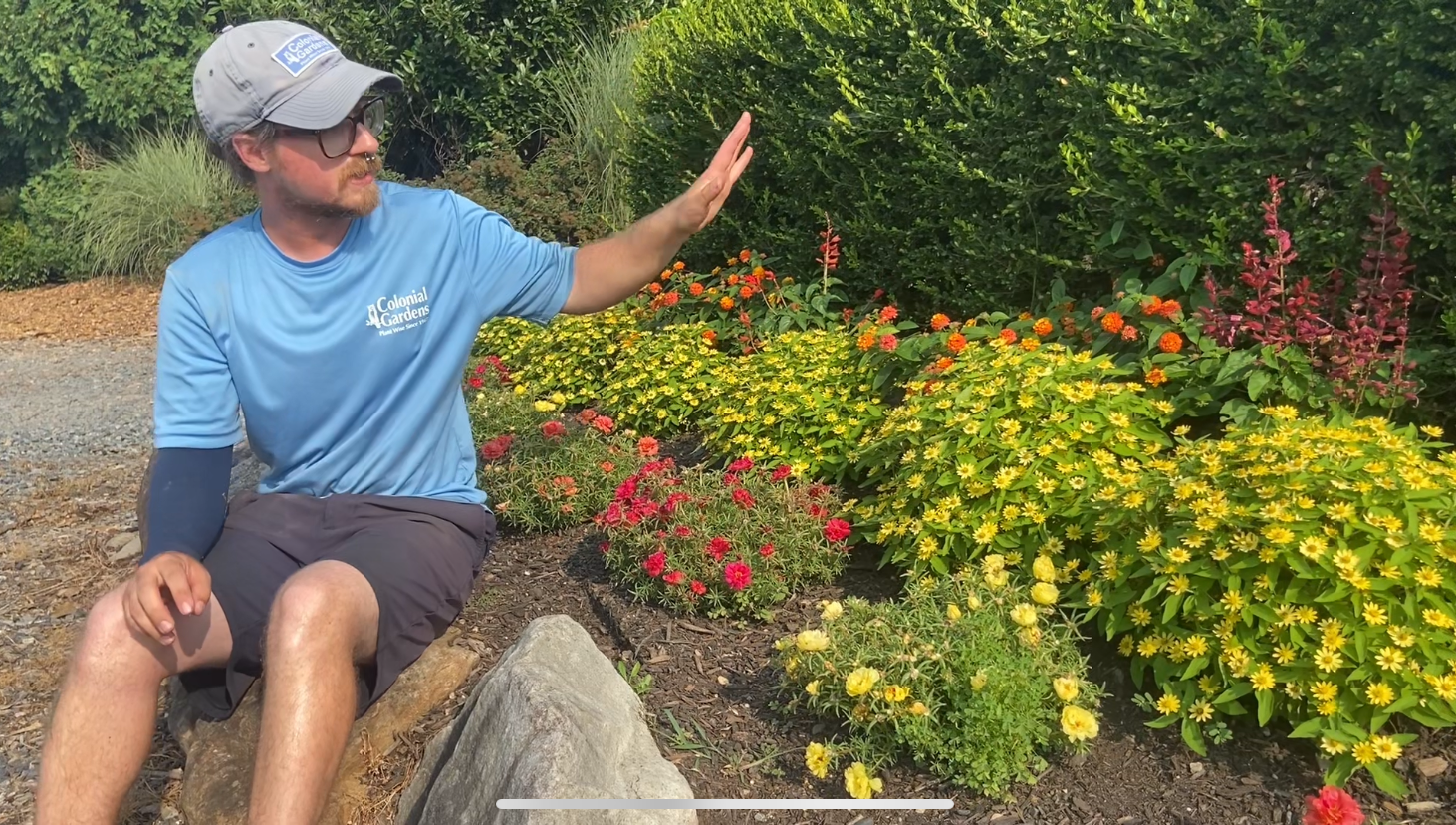
Finally, beautiful pictures of our own work! In the dead of summer when content feels hard to come by, we can check in on the test gardens. Staff who have expressed interest in being on camera now had a topic they felt confident sharing on our YouTube page.
In the spring, I can show pictures of the plants on the benches compared to what they’ll look like in three months.
ROI could be measured in social media hits, page visits for our blogs and number of content items produced by staff involved.
Reflections and the future
Our team is currently scouring our grower’s availability for their next test garden plants, and they're excited about what this year can bring. Here are a few ideas I want to explore to make these gardens even more successful and useful for our garden center.
Track specific varieties. Our staff didn’t always keep the tags from the annuals they planted, so we lost track in some cases of what varieties were used. That wasn’t a huge deal for the first year, especially since annuals change availability quickly. This year, we will keep the tags for our records.
Add signs. While it was in the original plan, I did not get a chance to add signs explaining the gardens. That is something we will definitely do next year to help customers know what varieties they’re looking at and to give credit to our staff who designed the gardens.
Track budget. In addition to the cost of materials, we could have staff estimate labor costs and compare the cost of installation versus their projected budget. We find that we often undervalue our own labor and underestimate the time it takes to complete a project.
Do more team check-ins. A lot of my feedback on their gardens came in one-on-one conversations with the employees and during our YouTube recordings. We could connect other employees or build more team connections if we examined the garden performance together.
Build in more cross-departmental goals. This year, Ashley will be designing her gardens around providing blooms for our florist. From there, we can add more content about harvesting and test the longevity of different varieties. Lindsay wants to test pepper plant success in different growing conditions, which we can use to compare potting soils and fertilizers. Pat wants to see if our resident hummingbirds truly prefer red flowers over others and is designing his garden accordingly. We can add these proven varieties to our summer hummingbird display with perennials and feeders.
This year, I will continue to seek out that measurable ROI. I will be challenging staff to use their knowledge to sell more of their favorite plants and to create content throughout the season, not just when the gardens are grown in.
I will still be keeping a close eye on making sure that we don’t lose quality in our basic job responsibilities in pursuit of our experiments.
Outside of solving the initial challenges I outlined, I think my favorite thing about our test gardens is that I got to know our staff better. I liked seeing their thought processes as they planned their gardens, what sparked their curiosity and how their thinking evolved this year.
Hopefully, they got to understand a bit better how I approach creative projects like this, fostering the fun elements while providing value to the store.
As they continue their employment with us, I hope we can use this as a cornerstone for growing their skills and feeling ownership over the success of their department and the pride in the place they work.
Latest from Garden Center
- Think like Disney
- Blue Grass Farms acquires Brehob Nursery
- Seed Your Future aims to double 2025 total for 'Round-Up at the Register' 2026 campaign
- Beacon Impatiens partners with Roots for Youth in 2026
- New internship data empowers horticulture employers
- American Horticultural Society announces winners of 2026 Great American Gardeners Awards
- Sustainabloom releases new sustainability template for wholesale florists
- How to help stop the spread of spotted lanternflies: Find egg masses