 Ian Baldwin“Christmas is coming, the goose is getting fat, please put a penny in the garden center owner’s hat” (with apologies to an old English nursery rhyme). Actually, I am not sure how fat the Christmas goose will be this year. After a stronger-than-expected spring, a flat summer and a surprisingly poor fall, owners are wondering what this economy and weather combination will throw at them next.
Following the boost from the “Grow Your Veggies” movement, customer count has dropped off across the country and is now flat or down compared with 2008 for many garden retailers. The economy had already made shoppers more careful with their spending, so most stores are also showing a drop in average sale.
Clearly, the glass looks a little less than half full to many seasoned owners and managers. But, as the Good Book says regarding this time of year, “I come bearing gifts” – gifts that are otherwise known as impulse sales, with which this industry has a very mixed track record.
Know Thy Customer's Emotions
I know that holiday impulse products are typically things like candles, extra ornaments, table top, maybe new music or even a container of winter color on the front porch. But for this holiday I am talking about personal, everyday emotional impulses for comforting the soul or easing the mind.
I am not talking about the well-known holiday tie-ins like Wilt Pruf, needle bags and extra light sets. What I want to see selling in garden centers this season are the kind of items that consumers buy every day – somewhere. A supermarket, drug store or a pet store’s basic items can be your “impulses.” After all, humans don’t stop being hungry, bored or stressed just because they are in your store.
When consumers feel concerned about their money, life or loved ones they turn to comfort items. After 15 months of negative news, consumers are ready for a little bit of temptation. They’re not signing up for a $1,000 spa visit, but a good-quality hand cream for under $10? Sure.
The 'I Deserve It" Buying Motive
I have written before about “self-gifting,” when customers justify to themselves that they deserve a beautiful orchid or a fragrant jasmine, because of their hectic life or the need to feel good that day. For years an increasing percentage of sales in gift, accents, floral, houseplants and color departments has been focused on self-gifting items. Why don’t you consider offering gourmet cookies, hot fudge, candies or an organic treat for the pooch for under $12?
If you have shopped at Staples lately you will have seen all manner of edible goodies, even Godiva chocolates. Every Home Depot seems to have water, snack foods and candy at the register – anything to make up for those nail guns that are not selling.
So, where are you in this mix? Can shoppers do impulse shopping at a garden center?
Of course, they can, and you can make it happen – quite easily, actually. Impulse products don’t always need to be pretty. Anyone who has seen that ad for the new high-tech mouse trap from Scotts will know it’s aimed at people who are averse to using a conventional mousetrap. I heard of one single-site independent hardware store selling more than 400 of the traps just by creating an impulse display to remind people of the ad they had seen on TV – pure impulse!
Consider the Opportunities
A GC with yearly sales of $2 million could have around 40,000 customers or register rings in a year. Connect this with the fact that more than two-thirds of all sales in a garden center are the result of impulse buying, and you can see the possibilities. And opportunity knocks especially loudly at this time of year, when impulse purchases are usually at their highest proportion, maybe over 80 percent.
Every garden retailer has items that the public no longer expects – or never did expect – it to carry. If your store has gone strongly into lifestyle and gift over the years, the unexpected might be lawn food! If you are big in bird supplies, why not add a few high-end pet gift items? If you have a café, why not carry impulse lines of produce or gourmet food?
Plan It, Janet
Impulse items are less price-sensitive because people spend less time considering the purchase. As they are bought on sight, sound, smell and POP message, impulse products also take less sales labor (hooray!). Impulse is about grab-and-go, so if consumers don’t see or know about these items, or find quick answers to their questions, there will be no grabbing – just going.
Consequently, the secret to increasing impulse sales is planning their exposure to the shopper. For you, that means creating multiple impulse-item locations, full shoppable displays, cute eye-catching signage and value pricing. Anyone who has shopped at L.L. Bean will tell you that the company’s signature “Lobstah Popsicles” are low-priced and everywhere, at every bend, every facing, every hot spot.
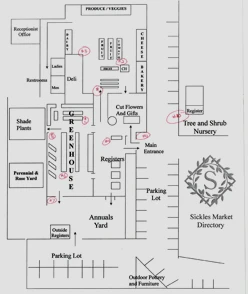
The first step then is to identify the “impulse points” in the typical customer’s journey through the retail area, picking out the top 10 hot spots at a given time of year. Sickles Market in Little Silver, N.J., did just that, and the results have been impressive (see the case study above).
Everyday Emotions Can Lead to Everyday Sales
There has been plenty written lately about getting back to home and garden basics, and, for the most part, I agree with this premise. We need to be seen as gardening centers again, no doubt about it. But to go alongside those everyday tasks at everyday prices, we also should spare a thought and some “impulse points” for those everyday emotions in what can be a stressed customer.
This holiday season (and the next and the next and … ) surprise your shoppers. Tempt them to relax and have fun. Make every day Christmas for someone!
|
An “impulse point” case study: Sickles Market, Little Silver, N.J. Working with the team at Sickles Market, we identified the 10 hot spots, across several departments, that were worthy of impulse displays. The cross departmental Merchandising Steering Team created a focus for the whole company, not just a few departments, on this initiative. In turn, everyone worked together for the good of the store – not just their individual departments. |
Explore the December 2009 Issue
Check out more from this issue and find your next story to read.