Editor's Note: This article originally appeared in the July 2025 print edition of Garden Center under the headline “Long Island reno.”

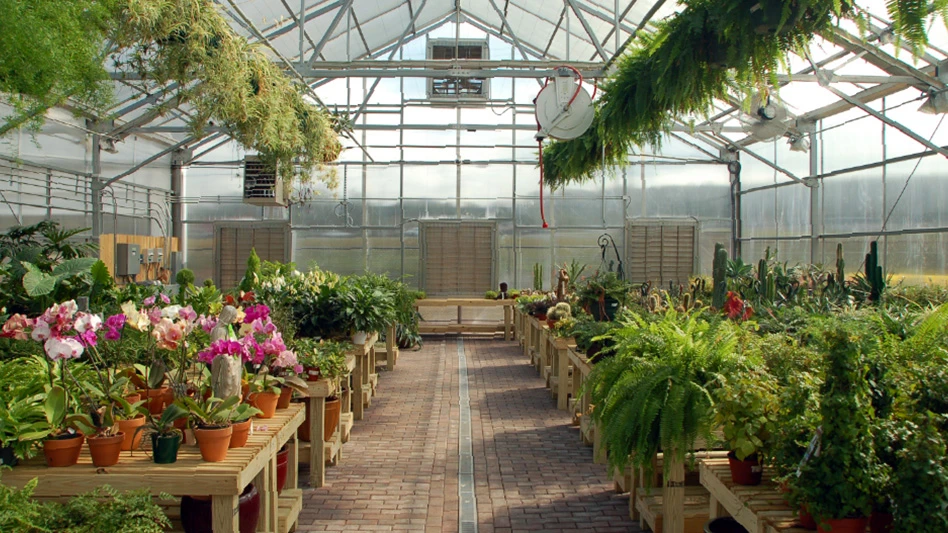
Photos by Chute Gerdeman for Hicks Nurseries
When Garden Center profiled Top 100 IGC Hicks Nurseries in 2023, sixth-generation President Stephen Hicks told us a dramatic remodel was set to begin.
Well-planned and executed, the makeover of the Long Island IGC was accomplished in slightly more than two months, with the store open for business the entire time.
Hicks has once again made the Top 100 Independent Garden Centers List, this year tied for the No. 2 spot.
We checked in with the 172-year-old business for renovation insights and frontline advice.
Fresh eyes, fresh ideas
Long Island’s largest garden center, Hicks has approximately 70,000 square feet under cover and 200,000 square feet of outside selling space. The renovation involved approximately 35,000 square feet of greenhouse and another 7,500 square feet of covered, air-conditioned space.
The first step in Hicks’ renovation process was in-depth consumer research. While the team had numerous ideas on how design changes could better serve their customers, Stephen Hicks says having fresh eyes from outside the company was valuable.
“We didn’t want to be just bound by what we knew or we think we knew about our customers. We wanted some data and some objective analysis to make sure that if we were going to make changes, it was based on what our customers actually think and not what we think we know,” he says.
To conduct the research, Hicks turned to leading retail research consultancy Envirosell. Based in New York City, the firm was founded in 1989 by Paco Underhill, author of “Why We Buy: The Science of Shopping.” Hicks, who had read the book and appreciated the firm’s proximity, researched Envirosell’s unique processes.
“What really appealed to me was the idea of looking at it not as a design question, but as one of research as to the customer’s mindset, experience and so forth, which they kind of really specialize in,” Hicks explains.
But Hicks emphasizes that IGCs can approach other research firms the same way.
The important part is getting actual customer feedback through surveys, interviews or observations, “as opposed to us sitting down and saying, ‘Well, here’s what the customer thinks,’” Hicks says.

In-store, customer-centric research
The Envirosell kickoff meeting was in early March 2020 — two weeks before COVID put everything on hold for a year and a half.
But once underway, Envirosell’s multi-step research process involved in-store observations of customers, customer interviews (complete with old-fashioned clipboards) and video cameras observing customer-product interactions — all of which customers were happy to participate in.
Hicks requested the research take place over the course of several of the IGC’s busiest days so they could understand the customer experience during peak times, not just in the off-season.
At one point, the firm recruited about a dozen customers to wear special glasses as they shopped the store. The glasses tracked not only what was viewed but where their eyes focused — for a true sense of the effectiveness of signage and other elements.
Upon completion, the firm distilled the information down and presented key findings to the IGC team.
Research takeaways
Hicks says the research results didn’t include any “earth-shattering” insights, but they did provide color and emphasis on experience.
For example, the research indicated that sightlines between areas of the IGC were restricted, hiding new areas to be explored. It also revealed that 70% to 75% of customer interaction with staff was around directional questions.
“That was interesting,” Hicks says. “The idea being that if we could improve our directional signage and navigation and we could minimize those questions, that might have a significant payoff in terms of freeing up staff time for other activities or more in-depth interactions with customers.”
Hicks Director of Marketing Eleni Roselli adds, “Engaging directly with our customers about their shopping experiences was invaluable. We gained a deeper understanding of their needs and preferences and used this feedback as the foundation of the store renovation.”
Hicks stresses hiring a research firm isn’t a necessity — you could do your own internal observations instead.
“My takeaway was the idea of really looking at the shopping experience through the eyes of the customer, without any sort of preconceived notions,” he says. “We felt that was the best way to answer those questions.”
After the in-store customer research launched the renovation project, the Hicks Nurseries team moved into the design phase.
Hicks compares it to a landscape design project — after the needs determination phase, the design had to bring those needs, objectives and goals to life in a plan.
Historically, the Hicks family worked with world-renowned garden center designer Ernest Wertheim of Wertheim, Van Der Ploeg, and Klemeyer, unquestionably the world’s premier IGC designer, who passed away at 100 years old in 2020. Wertheim’s last Hicks project was in 2007.
“We were spoiled, to be honest, in that we worked with a design firm for 30 years that knew us, knew our business, knew the industry inside and out, understood all of the issues about operating a garden center, and now we were kind of starting from scratch,” Hicks shares.
IGC idiosyncracies
Ohio-based experience design firm Chute Gerdeman won the project, helped along by a recommendation from Envirosell, the firm that did Hicks’ research. While Chute Gerdeman had extensive retail expertise, this was its first IGC.
Hicks explains that having a firm from outside the industry — with a different perspective, willing to ask questions and shake things up — was a positive. However, that fresh perspective came with challenges.
“There was a learning curve on them coming up to speed on the garden center business that, to be honest, any firm coming in who’d never worked in our industry would have had,” Hicks says. “And I think there were times when that added to the design process.”
Roselli notes, “Clear communication of goals is key when working with a design firm unfamiliar with the garden center industry. It’s important to invest time in educating them about the seasonal nature of our business, as that impacts design. Regular check-ins and collaboration are a must.”
Translating the IGC experience
Many elements of the renovation were driven by a maintenance perspective. The 27-year-old greenhouse facility — top-of-the-line when built — was showing its age. The polycarbonate roof had passed its life expectancy. Similar issues faced the underfloor heating and shade curtain system.
Faced with these inevitable needs, the question became how Hicks could tackle maintenance issues, address unique IGC challenges and elevate the customer shopping experience as well.
“There are unique challenges garden centers face in terms of moving volume in a short period. The perishability, the nature of the product, the fact we’re in a greenhouse. That’s another challenge in just the physical nature of the structure and the requirements for water drainage, light vents, shade systems,” Hicks says.
The Chute Gerdeman team was able to translate their retail expertise to the garden center space.
“They were very good at helping us identify our fixtures, our layout, our signage, which were the main objectives that we’d set out,” Hicks says.

Design takeaways
As with the project’s research phase, Hicks says the design plan didn’t surprise him. Many major changes — flipping the entrance and exit to the store, expanding aisles, upgrading the checkout experience and improving signage and sightlines — were ideas already percolating.
But Chute Gerdeman helped flesh those out and show what could be done. A lot of time was spent considering adjacent products and how things could be moved as well.
“The final result was probably not as radical as some of the first iterations that we looked at, which we kind of dug into it, and it became not practical,” Hicks explains. “You start with a more extreme design, and you end up somewhere in the middle, or maybe closer to where you are, but further than you might have gone.”
Hicks adds that front-end planning, both from design and construction perspectives, pays off — even though those dollars may be painful to spend. That means having some hard and challenging conversations rather than looking at your current design and just updating it.
“You may end up coming back close to where you were, but going through that exercise is valuable,” Hicks adds.
Following the research and design phases, implementation of the Hick Nurseries makeover was slated for July and August 2023.
The project missed its mark of a pre-Labor Day completion by just two weeks, but that was due to a few last-minute additions. The store remained open and fully operational the entire time.
“Throughout the store renovation, we made it a priority to keep our customers informed via email, social and signing both outside and inside the store,” Roselli says. “First, we wanted them to know we were open while under construction, and second, we wanted to create excitement around the new store shopping experience they could look forward to.”
Detailed, on-site management
Detailed planning and management were crucial in bringing the design to life, Hicks says. That included a construction manager on site every day, with daily, weekly and monthly objectives, to answer all questions and keep the project moving forward.
“In our industry, there’s only so many windows in which you can get construction done as a seasonal business,” he adds. “If you miss that window, there are real costs to missing it. Nothing’s perfect, but without a plan, you don’t stand a chance.”
During construction, the IGC was able to wall off the construction area and provide customers with another entrance, creating new traffic patterns (and learning quite a bit about what was possible with certain categories in July and August).
The team choreographed the construction so its Christmas Gallery and Animated Story areas were finished by Aug. 14, one month before the IGC’s popular Fall Festival. While construction elsewhere continued, new fixtures and merchandising in the areas were underway and ready by festival time.

Looking forward and backward
Hicks says a critical part of the planning process is understanding your deadlines and what it takes to meet them.
For example, the store had all new custom fixtures needed on-site by Aug. 15. Meeting that deadline required ordering the fixtures in April — in the heat of spring rush.
“Having that visibility of starting with your end date and working backwards was very helpful, because you may find there are deadlines that are very, very important that you have to decide six or eight months out,” Hicks explains.
With summer construction, many of those deadlines may end up falling in spring and can easily slip by otherwise.
The store today is a much cleaner, brighter, more welcoming environment, with a much grander front entrance, Hicks says.
“In my opinion, it’s just a much better store. We made significant changes to improve the traffic flow and customer navigation, so it’s a much easier store to shop,” he says. “I think we’re giving the customers a fresher, better experience, and hopefully one in which they’re going to say, ‘Yep, this is the kind of garden center I want to shop at now and into the future.’”

The real challenge ahead
With the renovation completed, Hicks says the easiest part — the construction — was over. Then the real challenge began.
“What ultimately determines the success is when you fill it with product. When you fill it with staff, and the customers show up, what’s their experience like? That’s really what is ultimately the make or break,” he explains.
The facility is a starting point, but it’s the people, the organization and the culture that give it life.
“That’s the challenge and the exciting part. That’s more difficult than just hiring somebody to tear down a wall or to build a new entrance,” he says. “That’s the work that’s ongoing and never ends.”
For IGC owners considering renovations, Hicks offers the following advice.
“Be intentional in terms of your vision and your design. Do your homework on the front end. Then, plan your execution at a detail level. If, at the end of the day, you can match that up with what the customer experiences, we at least stand a chance to be successful. There are no guarantees, but it certainly puts you in a spot to be the best you can be.”
More on the Top 100:
The 2025 Top 100 Independent Garden Centers List
Hear from Editor Patrick Alan Coleman on why we changed the list
Meet the Top 100: Vandermeer Nursery, #49

Explore the July 2025 Issue
Check out more from this issue and find your next story to read.
Latest from Garden Center
- Emerald Coast Growers celebrates 35 years in business
- Zach Galifianakis is hosting a Netflix show about gardening
- Society of American Florists seeks nominations for floral industry awards; deadline April 1
- Pioneering progress
- Seed Your Future releases internship data for horticulture employers
- National Garden Bureau, All-America Selections recognize pepper breeder Terry Berke, Territorial Seed Company President Tom Johns
- Cool tech for garden retailers
- The Growth Industry podcast Episode 10: State of the Horticulture Industry