This past winter, I was asked to teach two classes about propagation for our local Master Gardener Association. One was for the public, held in a local library, and the other was for the master gardeners gathered at the garden center where I work. At both classes, I began by explaining that there are some things that we should not propagate. Later, it occurred to me that this information isn’t just important to share with the public, but to stress with our employees as well.
Plant geeks love to share, and we like making more plants. The master gardeners enjoy trading plants and offering them at their annual plant sales. And many members of our team at Hyannis Country Garden work at this IGC because of their love of plants. When I brought in pieces of my Hatiora salicornioides for one employee, there were instant requests from five others for pieces of this plant. Yet as happy as I was to share cuttings of the plant commonly known as “drunkard’s dream,” I was also resolved to explain why many of the plants we sell cannot be propagated.
In 1930, the Plant Patent Act was passed in the U.S., allowing plant breeders and nurseries to protect newly developed plant varieties that were propagated through cuttings, grafting or other vegetative means. Being able to patent a plant was not only seen as a way for plant breeders to be rewarded financially for their hard work, but also as a means to encourage more people to develop plants with desirable characteristics.
The inspiration for the act came from Luther Burbank, who developed more than 800 strains and varieties of plants in his lifetime. When Congress was considering the Plant Patent Act in the years shortly after Burbank died, the inventor Thomas Edison spoke in favor of passing the legislation, saying that it would “give us many Burbanks.” Being able to patent plants makes sure that those who invest thought and time into new varieties will have an opportunity to profit from their efforts.
The practice of trademarking plants also protects the investment and work that goes into breeding and developing new varieties. Along with patenting, trademarking encourages breeders to continue to develop innovative plants. For many, a trademark is also an essential marketing tool.
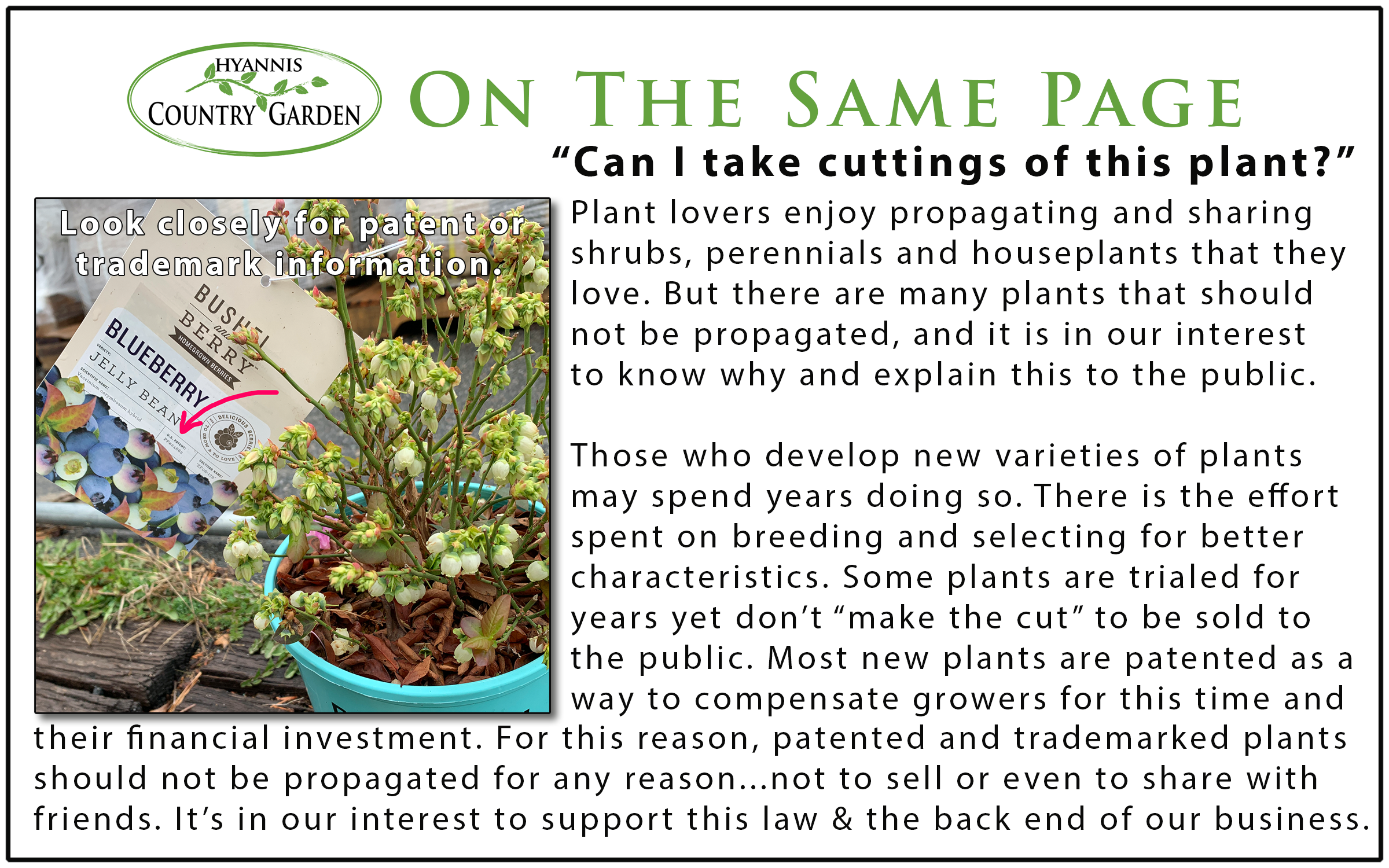
If they pay attention to the symbols on the plant tags, IGC employees will see that a good number of the plants offered for sale are either patented or trademarked — or often both.
When I spoke at the propagation classes, I explained that it’s against the law to take cuttings of these plants. “You can’t propagate these,” I said, “not for the plant sale and not to give to your sister or a friend.” I knew what question would be voiced next, so I waited a beat for it to come: “But how would anyone know?”
After affirming that there isn’t a Horticultural Police Force waiting to knock on a plant geek’s door, I first told them about a phone call that recently came into my radio program. “C.L.,” the caller began, “what do you know about patent pending?”
I asked if the caller was talking about a patented plant, and he affirmed that he was. It seems that he was so taken with a particular blackberry plant that he began taking cuttings from the one in his garden and offering them for sale online. Soon, he got a cease-and-desist letter from a law office representing the holder of the patent on that plant. When I explained the reason he received the letter, he started to deny there was a problem. “But they sell like hotcakes!“ he kept saying.
Since this enthusiastic plant propagator was selling these blackberries online, it was easy for the owner of the patent to track him down. They undoubtedly had Google Alerts set up for the name and description of these berries. Yet even if an amateur propagator isn’t selling on the internet, there are other compelling answers to the “how would anyone know“ question.
When it comes to the public as well as IGC employees, the answer is clear. It’s not that we’re afraid that someone will find out and have their attorney send us a letter. We don’t propagate trademarked or patented plants because we want to support the growers and breeders who help provide us and the public with new plants. In order for our customers to have interesting or improved plants, we should all champion those who find or develop those new choices.
“How will anyone know?” I answered the person in the library. “They may not know, but you will. We should do the right thing because it’s the right thing, not because we might get caught.”
Although one of our missions at garden centers is to encourage those who are enthusiastic about plants, we don’t want to do that in a way that undercuts other parts of our industry. We support those who patent and trademark plants, and educate our employees and customers to do so as well, because it cultivates us all.
C.L. Fornari is a speaker, writer and radio/podcast host who has worked at Hyannis Country Garden, an IGC on Cape Cod, for 30 years. She has her audiences convinced that C.L. stands for “Compost Lover.” Learn more at GardenLady.com
Latest from Garden Center
- National Garden Bureau, All-America Selections recognize pepper breeder Terry Berke, Territorial Seed Company President Tom Johns
- Cool tech for garden retailers
- The inventive women of TPIE ’26
- 10 questions with Jonah Nelson
- Quality Horticulture to acquire Hydrofarm Canada distribution
- From Structure to Storefront: The Retail Greenhouse Features Worth Planning For
- Growing flowers to grow confidence
- Think like Disney