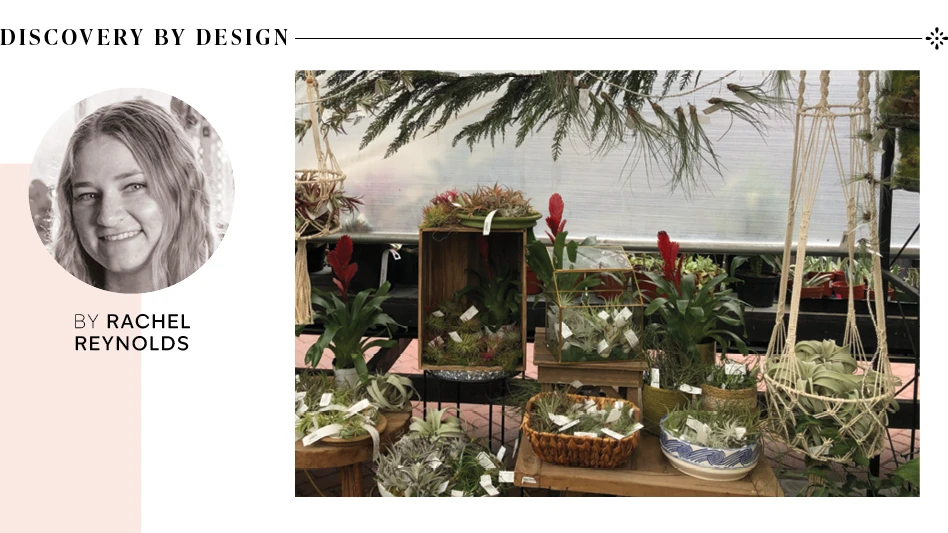
Photos courtesy of Rachel Reynolds
Editor's Note: This article originally appeared in the SPRING 2026 print edition of Garden Center under the headline “More than merchandising.”
Garden center merchandising is often treated like decoration rather than an essential tool that, when refined, can have a huge impact on the store experience. When displays feel chaotic, inconsistent or exhausting to maintain, it’s usually not a creativity problem. It’s the result of unclear vision, too much product and a lack of structure to support the people responsible for bringing these visions to life.
Visual merchandising is not just “creating pretty displays.” That’s what it seems like from the outside. It’s also what I believed at the beginning of my merchandising career in 2021 at Houston nursery Buchanan’s Native Plants. But now, I’m here to destroy the notion.

A visual merchandiser’s origin story
I began at Buchanan’s as a cashier while finishing my degree at the University of Houston. Retail science was my minor, and when I learned there was a visual merchandiser position (although filled at the time), I knew I was willing to wait for it. As a creative who was new to the plant world, it was the exact type of role I was seeking.
When I finally did land the role, I realized nearly everything I had been told in my merchandising classes was inapplicable to independent garden centers — an ultra-niche category with tons of special rules.
After working in the role and meeting merchandisers across all industries, I realized we aren’t simply visionaries with an effortless touch. The job is honestly a lot more logistical problem-solving and broken fingernails than it is posh design. I had to play problem-solver, engineer, communicator, idea generator, marketing genius and plant specialist all at once.
When I hear garden centers ask, “How can that be a full-time position?” I often think, “How could it not be?” Why would you not have a person making sure your store looks beautiful all the time? I believe the reason that more IGCs haven’t invested in merchandising roles is because there’s no framework or training for the talented individuals who probably already work there.
For example, in my first role, I had support and a generally clear direction, but no inspiration or detailed instruction. I stumbled over perfectionism, an inability to receive constructive feedback smoothly and a lack of communication skills necessary to get the help I was trying, but failing, to achieve.
Everything changed for me after one conversation with management. They wanted me to be more proactive, not reactive. They wanted me to form more positive partnerships with coworkers. The feedback was hard to hear but necessary to accept. It became my new framework.
Management wanted me to succeed, and they believed in me. Everything clicked when they told me, “We just want more touches of YOU around the store.”

What visual merchandising accomplishes
Visual merchandising is the flow of specific touchpoints in the store reflecting that unique garden center experience. These displays are the personality hire that isn’t on the payroll. They can project a cohesive, memorable experience to evoke the feeling that gets them to fill up their cart without a second thought — the feeling that makes them think, “I can’t leave here without buying something.”
I want customers to feel like they enter a portal when they enter the store, with beautiful plants, pottery, gifts, thoughtful signage and world-class customer service. My goal is that by the time they exit the store, they feel like they’ve just left a whirlwind romance movie. This is the kind of experience I want to have when I shop anywhere.
So now, we get to the how: How can we project our true store vision and give our customers the experience they just can’t get anywhere else?
Fewer SKUs, more sales
With any display, you have to be able to answer the question: “What exactly am I selling?” Because if you don’t know, the customer doesn’t know what to buy. We have to tell them what to buy by inspiring them, sweeping them off their feet and making their decision frictionless.
If you aren’t sure, try refining the question to: “What do I want to see gone the most?” Is it the new pottery collection that you want to move quickly during peak season? Do the orchids that have a short bloom time need to sell right away?
The biggest problem I see with most IGCs’ current displays is that they aren’t clear on what they’re selling, so the display reads more like decoration. A decoration-heavy display leads to customers approaching, making a comment like, “That’s pretty,” and then walking past because there are too many elements to choose from.
To prevent your display from being perceived as unshoppable decoration, lower the number of SKUs in the display. The problem isn’t that people don’t want to mess up the display; there are simply too many options for them to choose from, and they’re unconsciously scared they’ll make the wrong choice.
This is well-documented psychology. When people have too many options, it makes it harder to choose. Analysis paralysis kicks in, and we become frozen, scared to pick one thing and miss out on another. When you lower the number of different items in a display, you create a more focused theme and seamless customer experience.

A pep talk for creative choices
At garden centers, we aren’t just selling things as a means to an end. We are selling products that impact people and improve their quality of life. In fact, non-plants items like soil and fertilizer are necessary for customers to succeed.
We have total control over how we showcase these products. I always remind people, “If it’s not a brick-and-mortar building, it’s movable.”
When I worked corporate retail at a children’s store, visual merchandising was confined to a 50-page packet of planograms. There was no creative freedom.
At a garden center, the employees hold all the power. You can put anything anywhere, as long as it makes sense.
There’s a level of fear I see from employees, almost like they’re scared to put their creative vision on display. I’ve experienced this myself. It’s hard to put your work on display for all your coworkers and customers to see.
But once you push through that, abandon perfectionism and start moving mountains (or just a few shrubs and pots) to bring your displays to life, you will unlock creativity within yourself that you will never lose sight of again.

Explore the SPRING 2026 Issue
Check out more from this issue and find your next story to read.
Latest from Garden Center
- Cool tech for garden retailers
- 10 questions with Jonah Nelson
- Quality Horticulture to acquire Hydrofarm Canada distribution
- From Structure to Storefront: The Retail Greenhouse Features Worth Planning For
- Growing flowers to grow confidence
- Think like Disney
- Blue Grass Farms acquires Brehob Nursery
- The inventive women of TPIE ’26