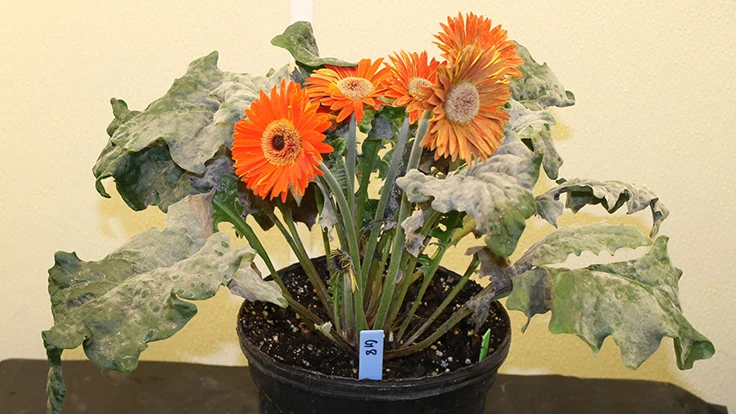
ALEXANDRIA, Va. – Nov. 3, 2015 – Powdery mildew is the most common and damaging disease for gerbera crops. The lack of disease-resistant gerbera plants has been a major limiting factor for crop production.
The American Floral Endowment's (AFE's) latest research report, Powdery Mildew Resistance in Transgenic Gerbera Plants, focused on increasing the plants' resistance to powdery mildew through gene transference.
Researchers Dr. Zhanao Deng, Zhonglin Mou and Natalia A. Peres of the University of Florida have concluded through this research that powdery mildew sensitivity can be overcome by transferring defense-related genes from non-crop plants to crop plants.
.jpg)
Severe powdery mildew on gerbera plants.
Results showed that genes from other plants can be transferred into gerbera crops to increase their resistance to powdery mildew. Regenerated plants had few mildew symptoms and better mildew resistance.
This information can be incorporated into breeding programs, and can help breeders manage diseases more effectively and control production costs. The study also offers the potential to develop disease-resistant varieties in other floriculture crops and for other diseases.
Visit Endowment.org for the full report and to access more than 150 free research reports covering disease management, insect management, post production, and more!
Latest from Garden Center
- Scientists develop vitamin A-enriched tomato to fight global deficiency
- Tennessee Green Industry Field Day scheduled for June 11
- UTIA and UT Knoxville research teams will develop automated compost monitoring system
- Ken and Deena Altman receive American Floral Endowment Ambassador Award
- Native before it was cool
- Proven Winners partners with Pure Line Seeds to offer vegetable plants
- [WATCH] Taking root: The green industry’s guide to successful internships
- Award winners announced for 2026 PHS Philadelphia Flower Show