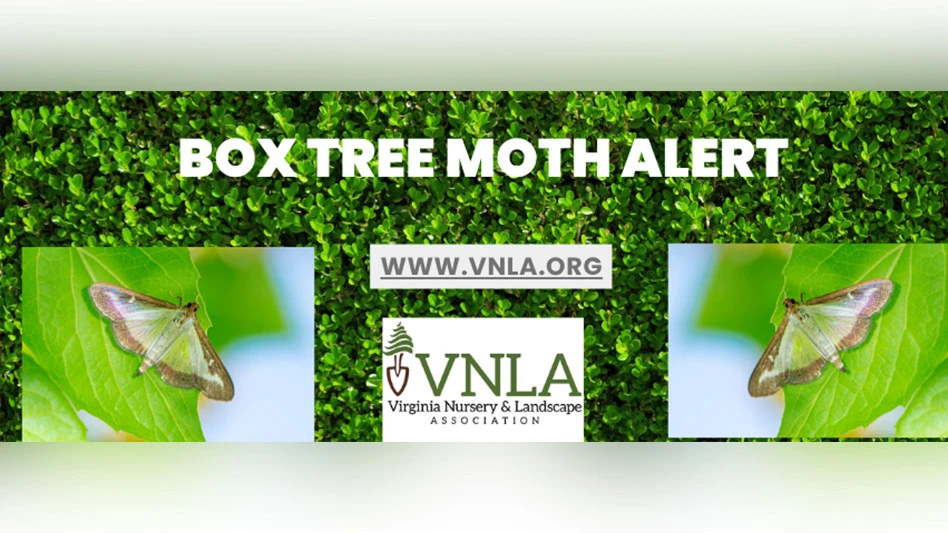
Photo courtesy of Virginia Nursery & Landscape Association
The Maryland Department of Agriculture and USDA Animal and Plant Health Inspection Service have confirmed the presence of box tree moth in Fort Frederick State Park in Washington County, Maryland. This is the first detection of the destructive pest in Maryland.
Box tree moth is a federally regulated insect and causes significant damage to boxwood. If boxwood plants are part of your life, you should be closely monitoring them for the moth and its damage.
Maryland Park Service staff are working this week to remove and destroy the affected boxwoods that were found at the park to prevent the spread of the invasive pest.
The box tree moth is a destructive pest of boxwoods, feeding primarily on them. They can produce multiple generations per year and, if left unchecked, can destroy the plant. The pest was first found in the U.S. in New York in 2021 and has spread rapidly, with populations found in Delaware, New York, Massachusetts, Michigan, Ohio, Pennsylvania and West Virginia.
Early detection is the key to preventing significant damage, loss and spread of the box tree moth. For information on how to identify and treat this pest, visit the University of Maryland Home and Garden Information Center website.
How to protect boxwood plants from box tree moth
- Monitor boxwoods in your landscape, looking for defoliation, bark stripping and webbing with caterpillars.
- The caterpillars are lime-green with thin black stripes and can be difficult to see when small. Full-grown caterpillars can grow to 1.5 inches. They are voracious feeders, and heavy infestations can completely defoliate host plants. Once the leaves are gone, they feed on the bark, eventually killing the plant.
- Webbing, created by the caterpillars, is most noticeable.
- Adult moths generally have white wings with a wide brown border. They are most active at night and may be hard to detect.
- Infestations may not be noticeable until significant defoliation occurs.
- Allow Maryland or federal agricultural officials to inspect your boxwood plants and place detection traps.
- Any infested material should be doubled-bagged in plastic bags and placed in the trash.
- Nursery owners should monitor their boxwoods and implement safeguards to limit pest risk. All licensed nurseries should report box tree moth detections to the Maryland Department of Agriculture Nursery Inspection Program or reach out to their nursery inspector.
The department will be working with the Maryland Department of Natural Resources on a treatment plan for the positive boxwood plants found in the state park as well as USDA APHIS Plant Protection and Quarantine to develop a federal quarantine for the pest.
If you suspect your boxwoods may be infested with the box tree moth, contact the Plant Protection and Weed Management program via email at ppwm.mda@maryland.gov with a picture attached.
Latest from Garden Center
- National Garden Bureau, All-America Selections recognize pepper breeder Terry Berke, Territorial Seed Company President Tom Johns
- Cool tech for garden retailers
- The inventive women of TPIE ’26
- 10 questions with Jonah Nelson
- Quality Horticulture to acquire Hydrofarm Canada distribution
- From Structure to Storefront: The Retail Greenhouse Features Worth Planning For
- Growing flowers to grow confidence
- Think like Disney