Gary Rohman - Rohman Photography
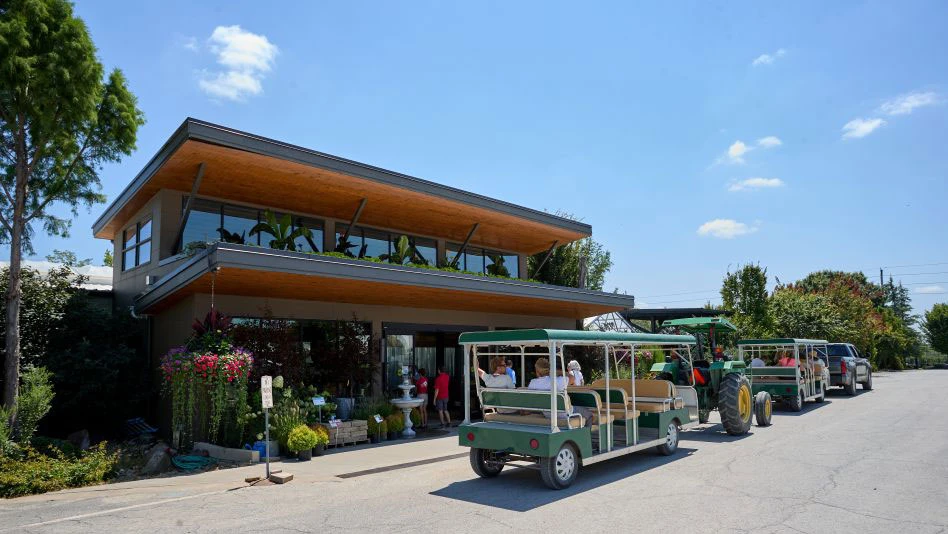
Powell Gardens, Kansas City’s botanical garden, has acquired independent garden center Colonial Gardens in Blue Springs, Missouri, the botanical garden announced in a press release Feb. 26, 2026.
Colonial Gardens — #64 on Garden Center magazine's 2025 Top 100 Independent Garden Centers List — has been in operation since 1969 and was purchased in 2016 by former CEO Tory Schwope, whose family owned the business under the name Schwope Brothers Tree Farm when he was a child.
Colonial Gardens was part of DCA Outdoor, which Schwope founded in 2016 as a parent company to house the 12 green industry brands he was operating across the supply chain, including nursery stock production, landscape distribution and retail garden center operations.
At the beginning of 2016, he acquired Colonial Nursery and rebranded it as Colonial Gardens. Since then, it has evolved to a locally focused plant emporium, event space, café and agritourism destination, pulling in nearly $6.2 million in revenue in 2025.
The Powell Gardens acquisition comes after Colonial Gardens' parent company DCA Outdoor, filed for Chapter 11 bankruptcy in February 2025. The filing allowed the Kansas City-based company to continue doing business while debt reorganization and bankruptcy proceedings took place.
Schwope is no longer an employee of DCA Outdoor, said DCA Chief Operating Officer Paul Abugattas, in an email statement. "DCA sold Colonial Gardens and the KAT Wholesale businesses to Powell Gardens as part of the restructuring efforts for DCA Outdoor," Abugattas said.
Financial terms of the acquisition were not released, but Jackson County, Missouri, property records show Powell Gardens purchased seven parcels from Colonial Gardens Development for $4.8 million.
Colonial Gardens video: Garden Center Conference & Expo tours Kansas City IGCs
History of Colonial Gardens
According to court filings, DCA’s 2024 financial results were adversely affected by several factors: a major customer’s refusal to pay for spring shipments, a plant disease at a key supplier’s Oregon facility and softer economic conditions. A combination of these factors led to lower than anticipated revenue and higher losses.
"It has been a challenging 2025 for the team at Colonial Gardens, but I am thrilled about the recent announcement of the sale to Powell Gardens," Abugattas said in a statement. "This acquisition will add a unique layer to this Top 100 Independent Garden Center, as Powell Gardens operates as a non-profit public garden."
Abugattas said in his initial years at Colonial Gardens, he met with the Powell Gardens team several times to discuss how Colonial Gardens could support Powell Gardens' mission.
"The team at Powell Gardens is exceptional, and I believe they will be outstanding partners in developing an even more unique independent garden center in the Kansas City area," he said. "The acquisition allows Colonial Gardens to continue operating and flourishing as an experiential agritourism site. The dedicated team at Colonial Gardens has worked hard to make this a special part of the community, and this journey is just beginning for them.
"I am proud of my time with this team and the small role I played in supporting the staff at Colonial Gardens," he continued. "I look forward to witnessing the successes that will come for the new team of Colonial Gardens and Powell Gardens, and I will be keeping an eye on this growing family in the years ahead."
Colonial Gardens in Kansas City: Regenerating community in Missouri
Why Powell Gardens acquired Colonial Gardens
Known for apple picking, seasonal festivals, plant shopping and school field trips, Colonial Gardens will become a second site of Powell Gardens, operating as Powell Gardens Colonial Farms.
“This is about honoring what people already love while building something even greater for the future,” said Cody Jolliff, CEO of Powell Gardens, in a press release. “Colonial Gardens has deep roots in this community. By bringing it into the Powell Gardens family as Powell Gardens Colonial Farms, we’re preserving a local legacy and expanding access to education, nature and meaningful outdoor experiences for generations to come.”
Powell Gardens Colonial Farms will become an extension of Powell Gardens’ Midwest Center for Regenerative Agriculture, serving as a hub for hands-on learning and environmental stewardship. Programming will include field trips for schools across the region; workshops focused on native plants, orcharding and sustainable farming; and community classes for home gardeners and hobby farmers.
“This isn’t just an expansion of property,” Jolliff added. “It’s an expansion of impact for kids, families, farmers, educators and the entire region.”
Powell Gardens said it's committed to maintaining signature experiences such as u-pick berries, flower cutting, the garden center and shopping experience, family-friendly festivals, school field trips and Whistle Stop Coffee.
Powell Gardens said the acquisition was made possible by a lead legacy gift from the Powell Family Foundation, which has supported Powell Gardens since the gardens' founding in 1988.
“We’re honored to support this major step in furthering Powell Gardens’ mission to inspire appreciation for the importance of the land and plants in our lives and to serve the Kansas City community for generations to come,” the Powell Family Foundation said in a statement.
Powell Gardens also thanked the Matthew Zell Family Foundation of Chicago for their partnership.
“Through the Midwest Center for Regenerative Agriculture, and now Powell Gardens Colonial Farms, Powell Gardens builds on its longstanding dedication to education and environmental stewardship while broadening the ways it can engage and support the Kansas City community,” said Aaron Zell, a director at the Matthew Zell Family Foundation. “We are grateful to the Powell Gardens team for their vision and focused efforts and look forward to this next chapter in Powell Gardens’ story.”
Powell Gardens will host a grand opening celebration March 20 and 21, 2026.
The Blue Springs site, which will be dedicated to agriculture, education and retail shopping, joins Powell Gardens' Kingsville location, which includes large-scale exhibitions and immersive garden experiences.
History of Colonial Gardens: A modern vision
Why did DCA Outdoor file for bankruptcy?
The GIE Media Horticulture Group talked with DCA founder Schwope in March 2025 to learn more about what happened and what was next for the green industry giant. Read that story here, or read portions of the story below:
It was all going according to Schwope’s plan to create a national vertically integrated business, controlling the supply chain from propagation to finished goods and the distribution of those goods.
The danger of acquiring so many nurseries is that real estate carries a lot of debt, and wholesale nurseries require a lot of real estate. Typically, Schwope would buy the operating company and set the real estate up on a lease-option contract. During the past four years, several of those options came due. Because of how much land value had appreciated, Schwope saw an opportunity and asked his lender, Farm Credit, to borrow funds to exercise his options to purchase the land.
However, as the nurseries continued to build inventory, the company’s debt-to-equity ratio tightened, and its overall borrowing continued to increase.
He always planned to recapitalize the business by selling some equity and thought there was still time, he says. At the end of 2023, Farm Credit told him, “You’re maxed out on the credit we are willing to provide. You need to get an equity deal done this year.”
Instead, three events occurred in 2024 that combined to create what Farm Credit considered to be a financial crisis.
First, a unique crop failure at DCA’s bare root fruit tree crop in Oregon led to discarding $3 million in sold inventory due to root imperfections and quality and disease issues. Second, a USDA quarantine because of a Phytophthora issue led to $20 million of inventory sitting for five months — a $4 million-plus disruption to revenue at that farm. Third, a major customer’s refusal to pay for spring shipments led to a $2.7 million uncollectible receivable. DCA Outdoor filed a lawsuit against the customer in September 2024, and it is progressing through court. However, Schwope is not optimistic about the chance of making up the loss.
“From a nurseryman’s perspective, all of these things would be considered your worst nightmares,” he says. “A crop failure, a USDA quarantine and then your largest customer failing and not paying you. We had all three of those things happen the same year.”
In early February, DCA Outdoor’s primary lender, Frontier Farm Credit, issued a notice of acceleration and reservation of rights on DCA’s $95 million debt with it.
“The old saying in the nursery business is be careful, don’t have much debt and be conservative because there’s a lot of things that can go wrong in this business,” Schwope says. “I don’t really consider myself a victim. I was fully aware that in this business, things can go wrong, and I didn’t have the company in the right kind of financial shape to be able to survive that kind of major disruption, so it’s on me.”
At the time of the interview, Schwope’s No. 1 goal for the restructuring was for DCA Outdoor to avoid a forced asset sale. He was confident the company would be able to do so, and he wanted to keep all of the brands that are part of the DCA portfolio.
“Everything we acquired had to be retooled, from the infrastructure on the farm, the equipment, the organizational structure, the technology, the product line,” he says. “We have been aggressive investors in all the businesses we acquired. We just basically finished rebuilding the entire thing to get it to work together the way it was designed. It would be incredibly wasteful and heartbreaking to bust it up right as we were finishing putting it all together.”
An unexpected lesson he’s learned through the bankruptcy process is that perception is reality. When your business faces bankruptcy, it’s a reputation hit, both for the company and the leader running it. Schwope underestimated how quickly sentiment would change.
He’s seen a change in the investors and lenders that are interested in talking to him, as well as a shift in the criteria they use. Before filing for Chapter 11, Schwope says investors were frequently excited about the upside of the business. Now, all they want to talk about is the downside.
Getting that label adds to the degree of difficulty substantially. It’s a challenging environment, but Schwope believes the only way to approach it is with a positive mindset.
“This is a tremendous opportunity to take a bad situation and overcome it. To have that on my resume and on the company’s resume is something that, once we accomplish it, nobody will be able to take it off.”
Latest from Garden Center
- Award winners announced for 2026 PHS Philadelphia Flower Show
- Art Van Wingerden appointed chair-elect of American Floral Endowment
- U.S. horticulture operations report $18.3 billion in sales: USDA
- Stonehouse Nursery announces ownership transition from founders to nursery manager
- From Structure to Storefront: The Retail Greenhouse Features Worth Planning For
- [WATCH] Taking root: The green industry’s guide to successful internships
- Green escapes: Garden Center Conference & Expo tours Kansas City IGCs
- BioWorks appoints Chris Rose interim general manager