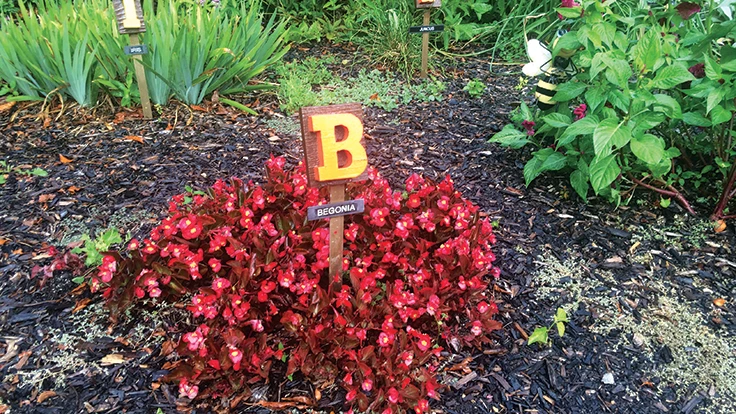
 In his first year on the job at Klehm Arboretum, John Moors, now the director of horticulture, tended to the alphabet garden, which has been an attraction at the public garden for at least 15 years. Like any “good gardener,” he says, Moors grouped the large plants in the back, small ones in front so all could be seen. His kids didn’t approve, however. “My kids straightened me out and said [the plants] should be in [alphabetical] order, left to right,” Moors says. And ever since, that’s how they’ve been organized at the Rockford, Ill., arboretum, even though at times it can be a challenge. Wooden letters created by one of Moors’ friends more than a decade ago are staked near the corresponding plants, which go by both common and scientific names. For example, B is for begonia, M is for marigold and X is for Xanthorhiza. “X was a difficult one,” Moors says. As was U, which was once a unicorn plant and now is an umbrella plant, and K, which is now Kniphofia. Another challenge is taming the plants to stay within their 30- to 36-inch plot. One season, a phlox grew to three feet tall and blocked the end of the alphabet. Challenges aside, the work is worth it. The garden impressed IGC Show attendees in Chicago, some who said they’d like to try the idea at their garden center. “We try to go with a lot of perennials, or annuals we know we are going to buy every year,” Moors says. “It’s worked out well, and it’s been a lot of fun. Kids as well as adults learn from it.”
Latest from Garden Center
- Scientists develop vitamin A-enriched tomato to fight global deficiency
- Tennessee Green Industry Field Day scheduled for June 11
- UTIA and UT Knoxville research teams will develop automated compost monitoring system
- Ken and Deena Altman receive American Floral Endowment Ambassador Award
- Native before it was cool
- Proven Winners partners with Pure Line Seeds to offer vegetable plants
- [WATCH] Taking root: The green industry’s guide to successful internships
- Award winners announced for 2026 PHS Philadelphia Flower Show