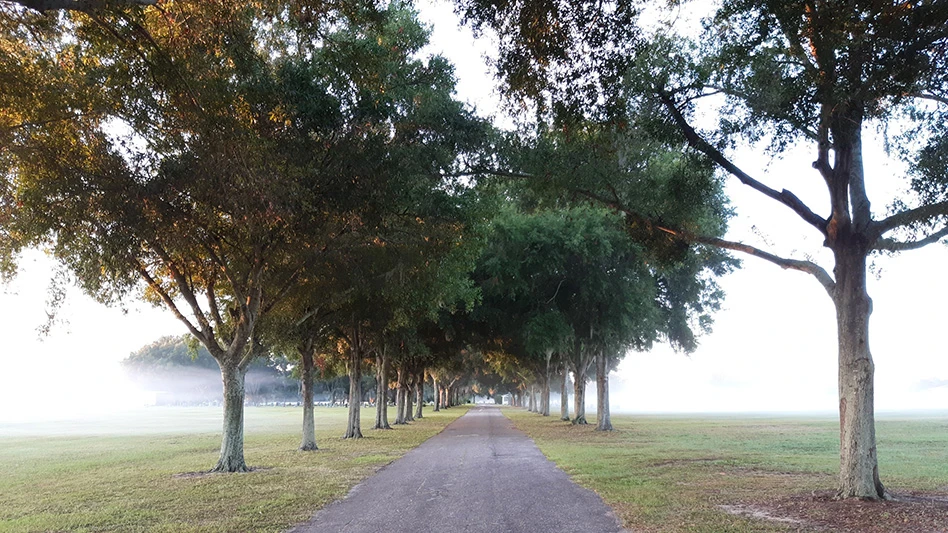
Honey locusts, especially the thornless cultivars, are popular ornamental and shade trees. Their thin, lacy canopy permits grass to grow right up to the trunk, and it’s a good tree for use where you want to see through the canopy.
Thornless honey locust is a picturesque landscape tree that was formerly planted in cities to replace American elms that died from Dutch elm disease. Nowadays, we have to be careful not to overuse honey locust, though.
Gleditsia triacanthos var. inermis is native to parts of the central Untied States. It is a medium to large deciduous tree that reaches 50-60 feet tall; its spread is usually equal to its height. Giant specimens in optimal habitats along riverbanks can be 140 feet tall and have trunks 6 feet in diameter.
Branching is upright-spreading to arching or more or less horizontal; some trees become nearly flat-topped. It casts only light shade. The tree develops a short main trunk.
Foliage is alternate, pinnately or bipinnately compound leaves, typically with many small leaflets. The bright-green glossy leaves are late to leaf out in spring.
In autumn, leaves turn a showy, clear yellow. Leaves typically drop early.
Small, greenish-yellow flowers appear in May and June; the flowers are fragrant, but don’t constitute a major ornamental feature.
One of the tree’s most memorable characteristics is its fruit. Twisted, flattened pods, 7-8 inches long and about 1 inch wide, can be numerous and messy. The straplike pods change from green to dark brown. Pods can persist on the tree after leaf fall into early winter. Seeds resemble oval bean seeds and are surrounded in the pods by a sweet, juicy pulp. During periods of drought, ranchers have been known to feed the seeds to cattle.
The tree’s attractive bark is gray-brown, developing elongated, smooth, platelike patches separated by furrows. The wood is very hard, heavy and resistant to decay.
Honey locust comes well-armed. The trunk and larger branches have rigid thorns that grow from deep within the wood. Most cultivars on the market have been selected from a thornless form.
The plant’s Latin name commemorates Gottlieb Gleditsch, director of Berlin Botanical Gardens, who died in 1786.
Some cultivars
Thornless cultivars are available, selected for sterility, foliage color, form and size.
‘Moraine’ is nearly podless, relatively resistant to mimosa webworm and grows 50 feet tall.
‘Elegantissima’ has a dense shrubby form and is smaller, to 25 feet tall.
Spectrum (‘Speczam’), from Lake County Nursery in
‘Imperial’ has a spreading form, 30 feet tall and wide, and produces few seed pods.
‘Shademaster’ is taller and narrower and almost podless.
‘Sunburst’ leaves are yellow when they first unfold and the tree is reportedly podless.
‘Pendula’ (aka ‘Bujotii’) is shrubby with slender, weeping branches.
Northern Acclaim (‘Harve’) is a thornless cultivar with better winter hardiness than other cultivars. It’s suited to Zone 3. In
Culture notes
Honey locust is a fast grower. Young specimens can put on 2-3 feet of height per year.
Provide full sun. Lower limbs die if they’re shaded but may remain on the trunk for years.
Honey locust is adaptable to a range of soils but grows best in deep, moist, fertile soils of neutral pH. Trees tolerate pollution and are said to be one of the most salt-tolerant trees, standing up well even along
Although honey locust grows naturally in swamps, it is surprisingly tolerant of drought.
Sow seeds in fall (scarify them first) and leave seed trays outdoors for spring germination. Thornless cultivars of honey locust are usually propagated by budding or grafting onto seedlings of the species. Honey locust transplants easily.
Watch for bagworm, spider mites, mimosa webworm, pod gall midge and cankers.
In the landscape, use honey locust as a lawn tree or street tree where space permits. It’s useful for the light shade it casts, which permits turf to grow beneath.
Some experts suggest tempering this species’ use in light of overuse in the past and the urban monoculture of honey locust.
Specifics
Name: Gleditsia triacanthos var. inermis
Common name: Honey locust, thornless honey locust.
Family: Leguminosae.
Description: Fine-textured shade tree that reaches 40-80 feet tall with an open plumelike crown that spreads 20-30 feet.
Hardiness: To USDA Hardiness Zone 4. Certain cultivars to Zone 3.
Landscape uses: Lawn tree, street tree, specimen. Owing to its potential for overuse, it’s best not massed.
{sidebar id=2}
- Kevin Neal
July 2008
Latest from Garden Center
- Jackson & Perkins expands into Canadian market
- Green & Growin’ 26 brings together North Carolina’s green industry for education, connection and growth
- Cincinnati Zoo & Botanical Garden debuting new perennial section at 2026 Breeder Showcase
- The Garden Conservancy hosting Open Days 2026
- Registration open for 2026 Perennial Plant Association National Symposium
- Monrovia's Bee a Winner program enrollment deadline approaching
- Fred C. Gloeckner Foundation Research Fund calls for 2026 research proposals
- [WATCH] The Cloud Makers inventor on how she made it rain at TPIE 2026