Water is a precious resource. Unfortunately, many growers often take their water supply for granted until its quantity or quality declines. Then they may be forced to adopt drip-irrigation methods or expensive filtration systems to collect and save water.
About 97 percent of the Earth’s water is seawater and another 2 percent is in the form of ice. Of the remaining 1 percent, as much as 75 percent is used by agriculture. Depending on crop, time of year and location, greenhouse and nursery crops may need as much as 0.4 gallons per square foot of growing space per day. This amount can exceed the available supply.
{sidebar id=52}
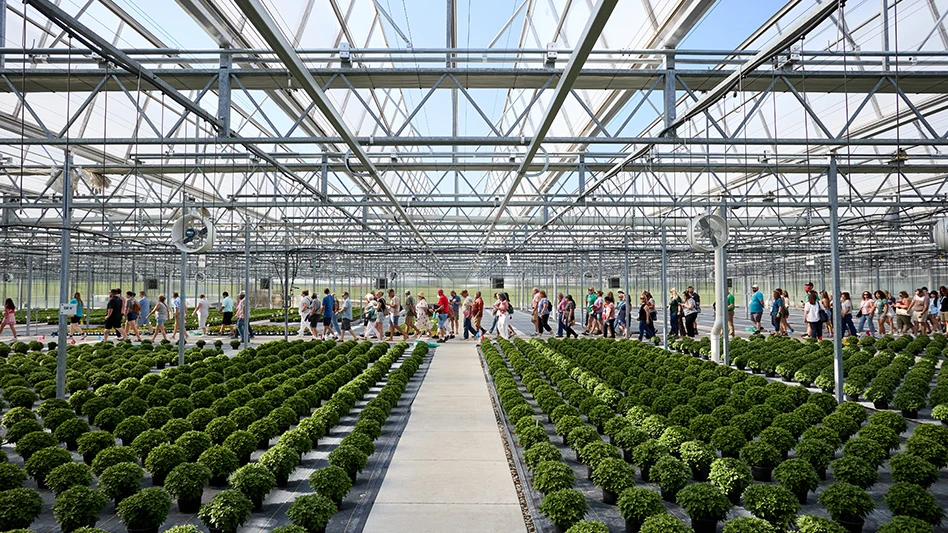
With the development of gutter-connected greenhouses, growers have the opportunity to collect large quantities of high-quality rainwater to use for plant irrigation. Rainwater harvesting is promoted in arid states, including
Rainwater specifics
Quality. Rainwater is generally soft with very few chemicals. It is clean except for debris that gets into the collection system. Rainwater may be slightly acid, so it may have to be treated.
Collection system. It is fairly easy to set up a collection system. In addition to the roof and gutters, you need filtration and storage systems. Where water is in very short supply, growers have captured rainfall from driveways and parking lots. It is also possible to add a gutter to the base of a hoop house and collect runoff water.
Pipe sizes. In most gutter-connected greenhouses, the gutters are drained through a downspout and piping system. Usually the downspouts are connected to a 4- or 6-inch PVC pipe. The downspouts are connected to larger pipes as more gutters are fed into the system. In large greenhouses, the end pipes may be 18 inches or larger. A minimum slope of 1/16 inch per foot with cleanouts every 100 feet is the recommend pipe installation.
Filtering. Before rainwater enters the collection tank or pond, remove debris. A roof washer is normally used to divert the first flush of water collected. This is a small tank that’s sized for the quantity of water collected. The sloped top is covered with 1/4-inch hardware cloth to trap and divert leaves. Dust, bugs, bird droppings and other small debris that get through the screen settles in the small tank and are drained away with a small pipe. Some systems have a diverter valve that switches once rainfall picks up. This tank has a full-size pipe at the top to carry the rainwater to a cistern, tank or water silo. Roof washers are commercially available or can be homemade.
Water storage
Concrete. A concrete cistern is a low-cost storage device. It can be a concrete septic tank that is set in place or a one that is cast in place. The largest septic tanks usually hold 5,000 gallons as this is about the largest size that can be handled on a delivery truck. Typical cost is $4,000-$5,000. Larger tanks are made by using forms filled with concrete. A good seal is needed between the base and sidewalls to prevent leaks.
Fiberglass and polyethylene. Fiberglass or polyethylene tanks are available as aboveground or buried tanks with the largest being 12,000 gallons. A 12,000-gallon tank measures 12 feet in diameter and 16 feet long. Depending on transportation costs, these tanks cost $0.80-1.25 per gallon. They come with threaded fittings for pipe connections and large manholes for cleanout.
Water silos. Water silos, manufactured by Zwart Systems, are corrugated steel tanks that can be assembled to provide a large water-holding capacity. A chemical-resistant liner is installed to contain the water. As the silos are formed in sections from sheet steel they are easy to ship and assemble on site. Tanks and silos inside a greenhouse or head house allow the water to be warmed before it’s used for irrigation.
Ponds. Growers with several acres of greenhouses usually build a pond to retain rainwater. Ponds can be any size but usually require a design by a licensed engineer and a permit from the local wetlands agency. If the soil is porous, use a vinyl liner on the bottom of the pond to prevent seepage. The disadvantage to a pond is that the water may become contaminated from algae or other plant growth.
Overflow. With any storage device, an overflow is needed to handle excess water. The water needs to be directed to a wetland or drainage area where it doesn’t flood neighboring property.
Calculating rainwater
A 1-inch rainfall on an acre of greenhouse amounts to 27,100 gallons of water. A common usable yield is 65 percent with losses due to evaporation, wind, pipe leakage and diversion of the first few minutes of the rainfall to remove debris. To calculate the gallons of water that can be collected, multiply the footprint of the greenhouse by 0.4.
{sidebar id=1}
- John W. Bartok Jr.
Latest from Garden Center
- UTIA and UT Knoxville research teams will develop automated compost monitoring system
- Ken and Deena Altman receive American Floral Endowment Ambassador Award
- Native before it was cool
- Proven Winners partners with Pure Line Seeds to offer vegetable plants
- [WATCH] Taking root: The green industry’s guide to successful internships
- Award winners announced for 2026 PHS Philadelphia Flower Show
- Kansas City botanical garden Powell Gardens acquires IGC Colonial Gardens
- Art Van Wingerden appointed chair-elect of American Floral Endowment