Univ. of Mass. Extension reports that late blight, caused by the fungus Phytophthora infestans, has been confirmed on either tomatoes or potatoes in New York, Connecticut, Pennsylvania, Maryland, Kentucky, Louisiana, Florida and Manitoba. On June 19 late blight was confirmed on tomato from a community garden on Long Island. The plants were removed and destroyed. On June 17 a plant pathologist confirmed late blight on tomato from a home garden in New Haven County, Conn. The plants had been grown from seed by a consumer.
Growers and gardeners are being advised that all potato and tomato crops should be protected with fungicides on a regular basis. Plants are growing rapidly, which means that unless a systemic is used, new tissue is not protected.
Once the disease is detected, plants should be removed and destroyed. No infected plants should be allowed to remain in the ground because they have the potential to serve as inoculum that can spread the fungal spores to other plants miles away.
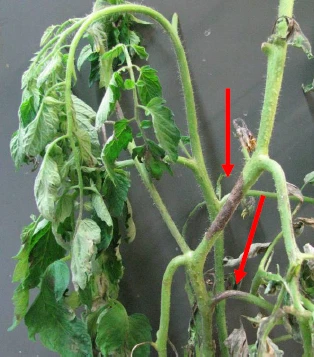
Plant pathologist Sharon Douglas at the Conn. Ag. Experiment Station said late blight symptoms on tomato are sometimes misidentified as Septoria leaf spot, caused by Septoria lycopersici, and early blight, caused by Alternaria solani. The most common symptoms on tomatoes are sunken, dark green or brown lesions on leaves and brown lesions on stems, with white fungal growth developing under moist conditions.
Pictured: Dry brown lesions on tomato stems caused by late blight.
Photo by Sharon Douglas, Conn. Ag. Experiment Station
Latest from Garden Center
- Proven Winners partners with Pure Line Seeds to offer vegetable plants
- Award winners announced for 2026 PHS Philadelphia Flower Show
- Kansas City botanical garden Powell Gardens acquires IGC Colonial Gardens
- Art Van Wingerden appointed chair-elect of American Floral Endowment
- U.S. horticulture operations report $18.3 billion in sales: USDA
- Stonehouse Nursery announces ownership transition from founders to nursery manager
- From Structure to Storefront: The Retail Greenhouse Features Worth Planning For
- [WATCH] Taking root: The green industry’s guide to successful internships