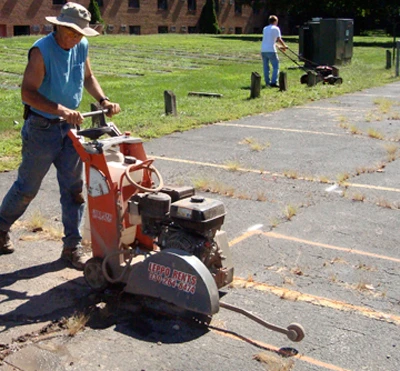
Old asphalt parking lots in urban areas tend to be cheap open land. Ohio St. Univ. associate professor Joe Kovach at Ohio Agricultural Research and Development Center in Wooster specializes in maximizing fruit and vegetable production in limited spaces. He is conducting a 3-year study to compare three methods of production (in giant-sized pots, in raised beds on top of the blacktop and in trenches cut right through the asphalt) in empty, abandoned parking lots.
“There are a lot of vacant parking lots in places like Cleveland and Youngstown,” said Kovach.
His study could boost the use of abandoned urban land. It could help people who live in areas having little or no access to affordable, nutritious foods grow more of their own fresh produce. Kovach recently completed a 6-year study of fruit and vegetable polyculture: “ecologically designed” mixed-crop plots that maximize biological diversity, minimize pest problems and earn the equivalent of nearly $100,000 an acre a year.
Pictured: Ohio State University associate professor Joe Kovach cuts trenches for his parking-lot urban garden test site in Wooster, Ohio..
Photo courtesy of Ohio St. Univ. Extension
Latest from Garden Center
- UTIA and UT Knoxville research teams will develop automated compost monitoring system
- Ken and Deena Altman receive American Floral Endowment Ambassador Award
- Native before it was cool
- Proven Winners partners with Pure Line Seeds to offer vegetable plants
- [WATCH] Taking root: The green industry’s guide to successful internships
- Award winners announced for 2026 PHS Philadelphia Flower Show
- Kansas City botanical garden Powell Gardens acquires IGC Colonial Gardens
- Art Van Wingerden appointed chair-elect of American Floral Endowment