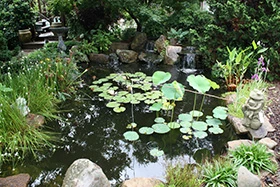
South Pleasantburg Nursery/Photo by Michelle Simakis One big trend in gardening is the desire customers have to create a relaxing, vacation-like getaway right in their backyards. Water helps create that setting, which is why more people are interested in installing ponds. But the myths about ponds can scare potential customers away. Ease their fears by busting these top five myths about building a pond.
1. Ponds mean more mosquitoes. Mosquitoes prefer to lay their eggs in stagnant, still waters which have little movement. Well-designed water features have pond pumps to keep water currents flowing. This naturally keeps the mosquito population down. Koi are another excellent way to keep mosquitoes at bay. They’ll eat eggs and larvae from the water’s surface.
2. Ponds require too much work. A balanced pond doesn’t take much work at all. Good pond filters, pond supplies, and knowledge will cut down the effort customers need to put into pond maintenance, and leave them more time to enjoy the beautiful water fixture.
3. Gravel and rocks on the bottom of a pond make it difficult to clean. Rocks, stones, and gravel on the bottom of ponds provide a habitat for beneficial bacteria. These bacteria assist in breaking down the waste ponds and fish generate. Smooth-bottomed ponds tend to accumulate muck. Gravel has an attractive look, as well.
4. Predators will eat all the fish. Predators in the environment may consider fish a tasty snack, but it’s easy to deter them and keep koi safe. Providing lily pads and rock formations for cover will give fish a place to hide. Motion-detecting sprinkler systems can drive predators away, too.
5. The fish will die when the water freezes. During cold seasons, thick ice often forms on the tops of ponds. Fish need sufficient ice-free space to hibernate over the winter. However, ice sheets only form to about an eight-inch thickness in the coldest climates because of how the earth insulates deeper waters. Koi can live happily in ponds of only two feet.
Information courtesy of Pondliner.com. For more, visit www.pondliner.com.
Latest from Garden Center
- UTIA and UT Knoxville research teams will develop automated compost monitoring system
- Ken and Deena Altman receive American Floral Endowment Ambassador Award
- Native before it was cool
- Proven Winners partners with Pure Line Seeds to offer vegetable plants
- [WATCH] Taking root: The green industry’s guide to successful internships
- Award winners announced for 2026 PHS Philadelphia Flower Show
- Kansas City botanical garden Powell Gardens acquires IGC Colonial Gardens
- Art Van Wingerden appointed chair-elect of American Floral Endowment