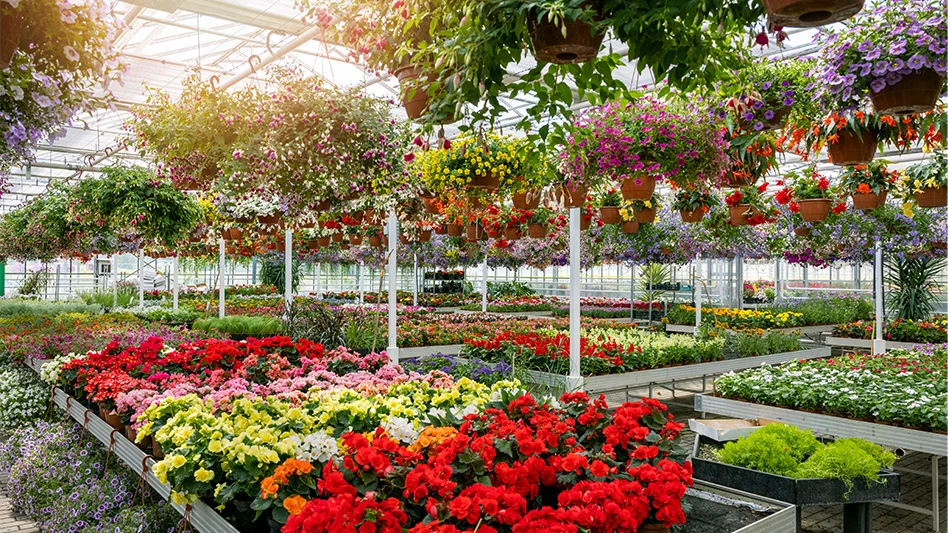
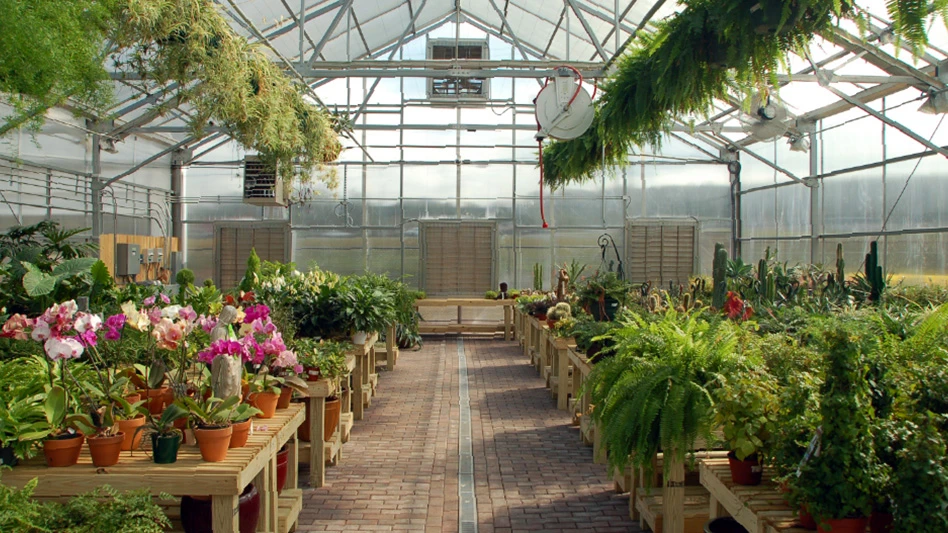
The challenge. As water crises become more common across the country, often due to poor community planning, all businesses are under pressure to reduce water use. Garden centers must keep plants alive, which means regular irrigation. How can they reduce water use without harming plants? Another major concern is water runoff. Water laced with garden chemicals that enters the sewage system or streams and lakes has been blamed for major environmental damage.
There are many ways garden retailers can reduce their water bills. The first target should be the biggest -- the amount of water used to irrigate inventory. Most garden centers already hand-water stock, which is much more efficient than overhead watering. How, exactly, can they reduce the amount of water used?
Water meters. Hand each person on your staff soil moisture meters to ensure that plants get only the water they need, suggested Denne Goldstein, publisher of Irrigation & Green Industry magazine. Current methods for telling if a plant needs water are age old -- pick it up to test its weight or poke a finger into the soil. The problem with these methods, said Doug Kieffer, soil and water product manager at Spectrum Technologies, is that the methods are subjective. First, employees have different skill levels. The less-experienced ones will water if they have any doubts. To them, it’s better to water too much than not enough. Even experienced employees can be thrown off by factors like time of day, lighting and so on.
Kieffer suggested that retailers test meters before handing them to employees. See what kind of reading you get with plants that are adequately irrigated. See what kind of reading you get from dry plants. Once you have a good range for plants that are adequately watered, you can train your employees on how to use the meters.
Eliminate sprinklers or overhead irrigation. Any irrigation system that allows water to go anywhere but in the desired location wastes water and often creates runoff. Tree and shrub departments are the usual culprits for this type of system. Many retailers have turned to drip irrigation for trees and shrubs, using tree-stabilizing frames to string tubing from plant to plant.
Throw out leaky watering wands or those without adequate cutoff valves. Water should only go into pots. If employees aren’t equipped with water wands that make it easy for them to cut off water flow between pots, then they will use the easy method of keeping water pouring the entire time they are watering, including between pots and benches.
Consider using modified flood tables. Flood tables modified for retail rather than growing are gaining popularity. Nexus is introducing tables this year that will require adding water only every few days.
Check for leaks. Check hose connections, the hoses themselves and spigots for leaks. It’s an easy fix that can save a lot of water.
Choose permeable surfaces next time you upgrade your flooring. With runoff becoming an important issue, the type of surface you choose for your nursery yard is important. Pea gravel and other unpaved surfaces are the most absorbent, but cause problems for customers wheeling carts. New types of asphalt allow water to filter through. Heavy rainstorms will still create runoff, but water will drain much more quickly with permeable asphalt than with traditional asphalt. Paving stones are considered by many to be the most attractive surface to use. By dry-setting stones and allowing minute spaces between pavers, paving stones can also allow for drainage.
Direct drains to a retention pond or onto a permeable surface. Those whose nursery yards and greenhouses have impermeable surfaces but use drains should direct to a filtering area. That area can be a bioswale, a retention pond or even ground treated with sand and gravel to allow water to percolate to the soil below.
Sweep aisles instead of hosing them down. The common practice of washing down the store with a hose should be replaced with sweeping. For larger garden centers, electric outdoor vacuums like the Billy Goat can speed the process.
Convert landscaping to water-wise gardens. You can use all the water-saving techniques promoted for home gardeners in your demonstration gardens or road-front landscaping. Smart controls work with local weather stations and do not allow watering during damp conditions. Exchanging sprinkler heads with rotators reduces runoff by rotating more slowly and using a lower volume of water. This allows water to be absorbed. Also, the head is designed to water at slightly different heights at each rotation, avoiding the traditional ring of overwatered areas with underwatered spots just below or beyond the ring. If you use drought-tolerant plants that perform well in your area, you will help influence customers to buy water-friendly plants.
Install rainwater systems. Attaching rain barrels to gutter systems on your building is very popular again. More extensive systems that attach underground plumbing that directs rainspout water to a holding tank make rainwater a more realistic water source for garden centers. Even with 17,000-gallon tanks, few garden centers can irrigate fully from rainwater. But this system can easily supply water for a section of the garden center and greatly reduce municipal water use.
{sidebar id=3}
Set aside room for a retention pond or bioswale. If you have room, a retention pond can make a very big difference in water use. Retention ponds can capture all water runoff from the garden center as well as capture rainwater. You would need a filter to eliminate sediment and other particles, and if you use synthetic fertilizers, you need to treat water before reusing it on your inventory. Even if you do not reuse the water, retention ponds act as a filter before water is reintroduced to the water table. Bioswales are shallowly sloped water systems, usually filled with plants, that are designed to filter water before it re-enters streams and lakes.
For more: Nexus Corp., (800) 228-9639; www.nexuscorp.com. Spectrum Technologies, (800) 248-8873; www.specmeters.com.
-
June 2008
{tab=Suggestions}
How do you get started in making your store more water efficient?
* Assess current and past water use. Collect the past years’ water bills to set a baseline that you will improve upon in volume and costs.
* Make a list of all areas where the garden center uses water. Chances are, you already know which areas of the store are water hogs. Keep these areas in mind when you assess any water-saving measures, since savings in the water-hog areas will have the biggest impact.
* Research which local natural water systems your runoff will enter. The runoff from your store goes somewhere. If you know which streams and lakes your water flows to, you can learn what contaminants are the biggest problems and assess if anything from your store contributes to the problem.
* Make small changes immediately. Many of the changes are easy enough, like sweeping pathways and fixing leaks, to implement immediately.
* Work out a budget and timeline for implementing larger projects.
* Designate a water-efficiency coordinator. If you have someone in charge of your water-efficiency program, it’s more likely to be implemented.
* Educate and involve employees in water-efficiency efforts. Everyone on the staff needs to understand why you are cutting back on water use or they will not take your changes seriously.
{tab=Reality check}
The bulk of our efforts are as outreach, education and gardening leadership. Our own in-house ship has not received as much attention. Nonetheless, here are a few things we do.
* We no longer wash off our sidewalks with hoses. Most garden centers routinely wash off their sidewalks of gravel and dirt. For 30 years we did this. We now use brooms and it works just fine.
* We wash all of our company vehicles onsite once every week. This includes four trucks and two vans. The waste water for this is collected in a drainage mat, completely contained and stays out of the watershed.
* We are getting bids and hope to soon retrofit our public restrooms with ultra-low-flow or even zero-water devices. This will include toilets, urinals and sinks.
Store landscaping
Certainly, our own new water-conserving landscape is our biggest water-saving improvement.
We have converted most of our extensive landscape planting here at our 7-acre store to what we call a California-Friendly garden. Our initial investment of approximately $150,000 includes a stunning demonstration garden featuring zero-runoff, weather-based satellite-controlled irrigation timers (called smart controllers), state-of-the-art high-efficiency sprinklers, etc.
We’re trying to use less water initially. That has to do with the plants selected, and if there are any thirsty plants, they are kept in one zone. We programmed it when we installed it (in February 2007), and haven’t had to do so again.
Prices for smart controllers start around $200 for the low end, although ours was about $700. In our market, there are significant rebates from the water district, and it paid 50 to 75 percent.
We wanted to demonstrate to the public how these kinds of systems work. We have a working model near a service booth, in a big display.
The sprinklers are rotators. The rotators do two things: apply water more evenly and more slowly. The head spins on the top, so each time the water goes around, it hits in a slightly different location. They deliver the water far slower. The standard for sprinklers is 3 gallons per minute; the rotator is 1 gallon per minute. That makes the water more likely to be absorbed. It percolates in more slowly.
Outreach efforts
We are on the forefront in the nursery industry here in teaching and demonstrating water-efficient approaches to landscaping. We have taken a significant position as the leader on these issues in our market.
* We have embraced the term California Friendly as the name for this approach to conserving and sustainable gardening.
* We are the creators of the California Friendly Gardening Contest, now in its second year. Although Roger’s Gardens runs this contest and does all the organizing and most of the work to make it a reality, its success is due to a coalition, including water districts, municipalities, clean-water organizations, University of California, local media organizations and private industry.
* We are now an organic-only business. We no longer recommend, stock or sell synthetic nutrition, pest control, fungicide, snail controls, etc. We are certainly the largest independent garden center in the country to take such a position.
* A significant portion of our seminar and education program is dedicated to low-water, zero-runoff, organic approaches. In fact, our new 10-month series is titled Gardening Naturally and is completely devoted to this approach.
Our public relations and marketing people have provided us with numerous media opportunities revolving around this approach to gardening. This has included television, radio, magazine, newsprint and Web exposure all because of our emphasis in this area.
- Ron Vanderhoff, Roger’s Gardens, Corona del Mar,
{tab=Product feature}
Insecticides and fungicides
Curious about how organic insecticides work? We’ve put together a quick-action reference on common active ingredients of controls on the market. We’ve also included a brief summary of common fungicides.
Insecticides
|
Action |
Products |
How it works |
|
Infection |
Bacillus popilliae or B. lentimorbus |
The bacterium is also known as milky spore disease and controls Japanese beetle grubs. |
| |
Rotenone |
Rotenone is both a contact insecticide and a stomach poison that controls beetles, weevils, slugs, looper caterpillars, mosquitoes, thrips, flies and mites. |
| |
Spinosad |
When ingested, spinosad affects the nervous system and results in death within a day or two. It’s touted as a Bt replacement. |
|
Contact |
Citrus oils |
Citric oils, made from peels, destroy the waxy coating of insects’ respiratory systems. |
|
Diatomaceous earth |
Diatomaceous earth is an abrasive powder that cuts the exoskeleton of crawling insects. | |
|
Insecticidal soaps |
Insecticidal soaps are primarily salts of fats and oils found in animals and plants (such as oleic acid, made from olive oil and other vegetable oils). Insecticidal soaps work by dehydrating soft-bodied insects. | |
|
Horticultural oils and sprays |
Horticultural oils work by coating insects’ airways, as well as eggs, and suffocating them. | |
|
Pyrethrins/pyrethrum (African chrysanthemum extract) |
Pyrethrins disrupt insects’ nervous systems. | |
|
Repel |
Hot pepper wax |
Hot pepper wax repels aphids, cabbage loopers, beet armyworms, spider mites and whiteflies. It lasts up to 30 days and does not wash off easily in rain or irrigation. |
|
Neem oil |
The active ingredient in neem is both a feeding deterrent and a growth regulator. | |
|
Other oils |
Garlic, clove, cedar, lavender, eucalyptus, pennyroyal, citronella and other extracts/oils (not to be confused with horticultural oils) work by repelling insects from eating, and by smothering insects. |
Fungicides
|
Products |
Summary |
|
|
|
|
Copper sulfate |
Copper should be used as a preventative only. Copper will not break down in the soil. |
|
Lime sulfur |
Lime sulfur controls foliar disease as well as mites, psyllas and some sap-eating insects. Do not overlap with horticultural oils. |
|
Streptomycin and terramycin |
These are fungal-derived antibiotics and are used to treat bacterial diseases. |
|
Sulfur |
Sulfur controls mites and prevents foliar disease. Do not apply to plants treated with horticultural oil within the last four weeks. Sulfur is corrosive to metal, so it should be applied with a plastic sprayer. |
{tab=Solutions}
Hand cleaner
Latitude 43 Inc. introduced a certified organic foaming hand cleaner for gardeners, landscapers and all working hands. This super-strength hand cleaner uses the power of nature to clean without the effects of harmful chemicals. It leaves hands clean, soft and supple after a day in the garden.
Composters, rain barrels
New eco-friendly Rotary Composters and Rain Barrels are made from African oak barrels once used to ferment red wine at
Compost caddy
This high-quality European compost caddy is sturdy, lightweight and has a tight-fitting lid. The caddy has an activated charcoal filter in the lid to neutralize odors. Filters last up to four months. The caddy is made in
Composter
The Spinning Composter has a cylinder dimension of 33 inches long by 39 inches wide by 36 inches high, with frame. It is made from recycled plastic and has a 7-cubic-foot capacity.
‘Green Gardener’s Guide’
“The Green Gardener’s Guide: Simple, Significant Actions to Protect and Preserve Our Planet” equips gardeners with common-sense tools to protect the Earth’s resources. The 352-page book provides hundreds of tips on conserving resources, promoting healthy and safe plant growth and preventing unnecessary damage to the Earth.
Plant food
Daniels Retail Plant Food 10-4-3 is the same formulation that professional growers have used for years. It is packaged in sizes suitable for home gardeners: 3.4-, 16-, 32- and 64-ounce jugs. A 32-ounce jug makes up to 182 gallons of finished product.
{/tabs}
Latest from Garden Center
- The Growth Industry Episode 10: State of the Horticulture Industry
- Scientists develop vitamin A-enriched tomato to fight global deficiency
- Tennessee Green Industry Field Day scheduled for June 11
- UTIA and UT Knoxville research teams will develop automated compost monitoring system
- Ken and Deena Altman receive American Floral Endowment Ambassador Award
- Native before it was cool
- Proven Winners partners with Pure Line Seeds to offer vegetable plants
- [WATCH] Taking root: The green industry’s guide to successful internships