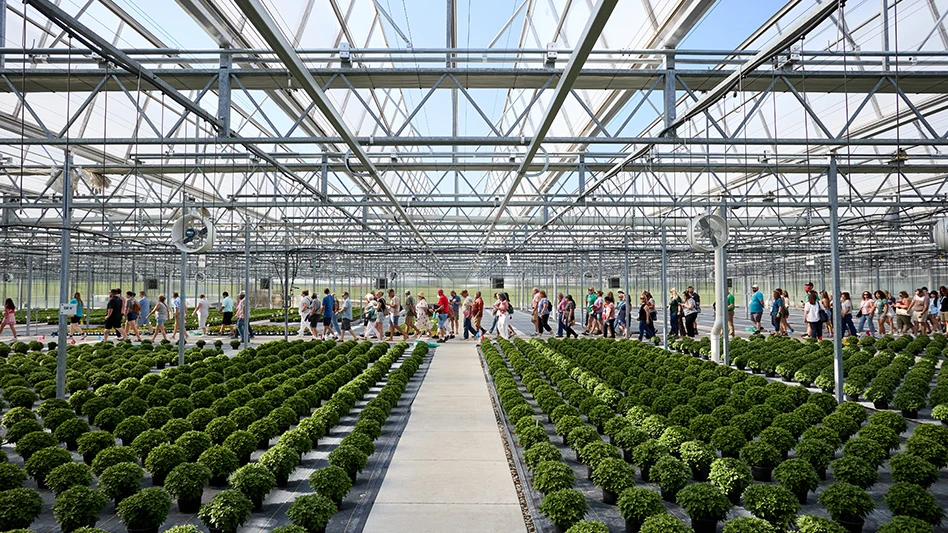
Adding additional growing space without building a new greenhouse can be done with a rack system. Racks can increase the effective space to more than 100 percent of floor area. The four designs described here are made so that they are easy to set up or remove. They also can be stored in a small space when not in use.
{sidebar id=52}
Standard construction materials
One of the best materials for building a rack system is pipe. Common galvanized or black water pipe can be used, but a less expensive choice is galvanized tubing or fence pipe. Many greenhouse manufacturers use this material, so they may be a good source. The pipe can also be purchased through steel companies or fencing suppliers.
Two of the designs shown use framing lumber. Low-cost native, rough cut material is the least expensive, but for a maintenance-free system select pressure-treated lumber.
Most pressure-treated material available at home centers is either ACQ (alkaline copper quat) or CA-B (copper azole). The material labeled for aboveground use is adequate for greenhouse racks. It contains less preservative than lumber that comes in contact with the soil. Hot-dipped galvanized or stainless-steel fasteners are recommended for corrosion resistance.
The dimensions shown are approximate and can be varied to fit the type of crop and container you use. Space between frames along the length of the rack system can be 8-12 feet unless large or heavy containers are supported. The aisles between racks should be wide enough for convenient access and plant handling. Two feet is usually minimum, but a wider distance may be needed, especially if more light is desired for the plants near the bottom racks.
Locate for maximum sunlight
Generally, racks are placed in a greenhouse to run north-south. This arrangement gives equal light to all the plants as the sun travels across the sky during the day.
Most rack systems are supported on the floor. A solid footing is needed to keep them level. The edge of a concrete walk or a buried solid concrete block works well.
Before attempting to support a rack system from the greenhouse frame, be sure that the structure can handle the extra load. Most crops will add 4-5 pounds per square foot to the structure. Most hoop house frames are designed to support a total load including snow and wind of 15 to 20 pounds per square foot. These frames could be easily overloaded with the addition of racks and plants. Most gutter-connected greenhouses with an energy truss are designed to carry the extra load.
Efficient use of racks
A drip- or trickle-irrigation system is commonly used with racks to reduce labor. For fixed pot spacing, in-line emitters work well by attaching the supply pipe to the bottom of the support pipe that holds the plants.
For randomly spaced containers or where different size pots may be used, a spaghetti system with 12- to 18-inch tubes works well. The supply line can be easily attached to the support with plastic wire straps.
When using a rack system, it is convenient to take advantage of the different light and temperature levels between the top and bottom. Light levels may be several hundred footcandles less on the lowest level. Unless an air-circulation system is in operation, the temperature can also vary from 6°F-8°F degrees between the top and bottom. Some growers use the floor area under the racks for newly planted containers or for growing herbs and groundcovers.
{sidebar id=1}
- John W. Bartok Jr.
Latest from Garden Center
- Proven Winners partners with Pure Line Seeds to offer vegetable plants
- [WATCH] Taking root: The green industry’s guide to successful internships
- Award winners announced for 2026 PHS Philadelphia Flower Show
- Kansas City botanical garden Powell Gardens acquires IGC Colonial Gardens
- Art Van Wingerden appointed chair-elect of American Floral Endowment
- U.S. horticulture operations report $18.3 billion in sales: USDA
- Stonehouse Nursery announces ownership transition from founders to nursery manager
- From Structure to Storefront: The Retail Greenhouse Features Worth Planning For