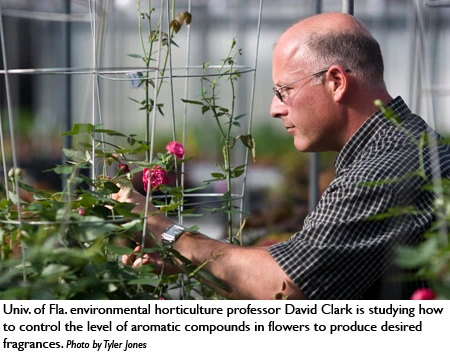
Flower fragrance has taken a back seat to other plant and flower characteristics. Univ. of Fla. environmental horticulture professor David Clark said that breeders mostly focused on selecting flowers based on their looks, size, color and vase life. This selection process inadvertently lead to the development of plants that produce little fragrance. But scent could make a comeback.
In the January issue of The Plant Journal and February issue of Phytochemistry, Clark and his colleagues discuss how various genes in petunia help to regulate the amount of 13 major aromatic compounds in the flower’s fragrance. The research will assist scientists in controlling these compounds so that the intensity of a flower’s fragrance can be adjusted. The research also discusses how flowers produce scent. In petunia the scent is produced primarily in the flower petals and is activated when the flowers open.
The studies are part of an ongoing effort to isolate the chemical pathway responsible for producing scent. The goal is to be able to modify fragrances without interfering with other flower qualities.
Latest from Garden Center
- The Growth Industry Episode 10: State of the Horticulture Industry
- Scientists develop vitamin A-enriched tomato to fight global deficiency
- Tennessee Green Industry Field Day scheduled for June 11
- UTIA and UT Knoxville research teams will develop automated compost monitoring system
- Ken and Deena Altman receive American Floral Endowment Ambassador Award
- Native before it was cool
- Proven Winners partners with Pure Line Seeds to offer vegetable plants
- [WATCH] Taking root: The green industry’s guide to successful internships