The Garden Corner in
“In the past, garden centers were all about our product: the best hanging baskets, the best plants, the best pottery. It was all about the stuff,” Karsseboom said. “We tried to build a nice store and have people come in. All of retail is like that, from Target to Home Depot. It is all about the product: ‘We carry the lowest prices, largest selection, give the best service,’ etc.”
What The Garden Corner does differently is training the right people to fit the store.
“I’m trying to do the exact opposite of what most retail does; I’m starting with the person and trying to figure out what is it that we can do to meet their needs,” he said. “It is not about splitting demographics. It is all about the individual.”
Computers can carry a lot of the weight now, Karsseboom said. If a customer likes to be left alone, staff makes a note of that. If the customer has a shade garden and it is his big hobby, that’s noted, too.
“We make notes of the smallest details,” he said. “If you are particular about your car and like to keep it clean, we’ll put your product on a delivery truck instead of in your car. If you’re a stockbroker and every minute of your day is scheduled, we put all those notes into a computer and we use that.”
Staff works to tailor the store to each customer’s individual needs. It is difficult to do and to carry out, he said.
“We assume much more responsibility. But in exchange, I think we gain much more satisfaction just knowing how to help people, and the customer gains so much more, too,” Karsseboom said.
One example of how the staff tracks a customer is noting that she purchased a hanging basket last year, but she had problems with bud worms in the summer months. By making a note of this, the staff can send her a note when the largest selection of hanging baskets is available and also remind her that she may need a remedy for bud worm so it doesn’t happen again.
“That is taking retail to the next level,” he said. “It says that we understand you, we want to help you and we’re going to make it easier for you.”
The book that inspired the store’s personality
“My innovation -- admittedly -- is wholeheartedly a copy,” Karsseboom said. “We use Jack Mitchell’s book ‘Hug Your Customers’ and we use his book as our owner’s manual. Every member of our staff gets a copy. We have gone over the book many times reviewing it chapter by chapter. Do we do everything in there? No. But we are on our way.”
Karsseboom also follows Mitchell’s next book, “Hug Your People,” which focuses on staff management.
“It is all about how to manage people and bring out the best in them,” he said. There is a way to bring out the best in everyone no matter what talent they have. I am most particular that our staff have that natural ability to read people to understand and to listen.”
Mitchell calls those people “huggers,” Karsseboom said. If they don’t have that quality, then they’ll either fit in elsewhere on the team or they won’t make the team.
“My biggest responsibility is to put huggers on the floor. Out of 1,000 people, you might find one. When the talent shows up, it is really like finding a jewel. It is difficult, but not impossible,” he said. I’m still in the learning process on how to keep the staff, and I’m just the beginner in that. You have to hug your huggers and know what makes them tick. Some folks like constant feedback, some don’t want that feedback -- you have to understand their quirks.”
A distinctive walk through the store
The site where The Garden Corner is located was purchased in 2000. The 34-year-old site was owned by a couple growing geraniums in greenhouses. They were retiring and moving away and Jack Bigej, owner of Al’s
“We started out thinking that we can do a shade garden there and things got carried away. With no concept of what it cost to do this and cost to do that, we just liked it,” he said. “Anyone in their right mind would have done otherwise.”
Without any buildings – other than the house where Karsseboom and his wife live – the 2-acre site was converted to a retail location and the greenhouses were changed to become more customer friendly.
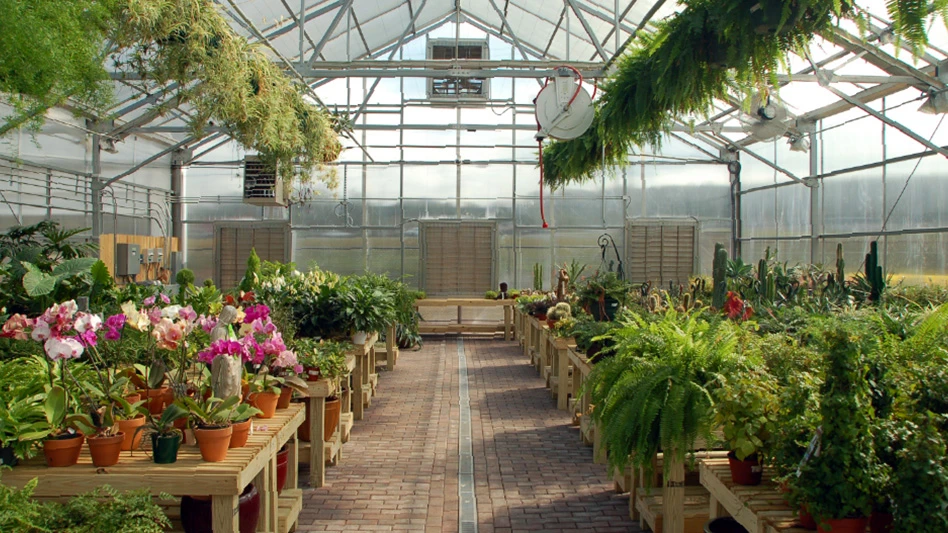
One of The Garden Corner’s most recognized features is the cedar walkway, which was born out of necessity.
“It was raining like crazy and we were ankle deep in mush,” he recalled. “We had to figure out a way to keep people above ground. The neat thing about that is I was able to make sure everything is flexible and changeable. I wanted to have material I could change, so we created a cedar walkway. We’ve used it for three years, and it’s lasted so far.”
The walkway winds through the entire nursery to encourage traffic to all parts of the site.
“We have to change it with seasons and we had to find a way to get customers into an undercover area,” he said. “It is meandering and the traffic flow is great, especially in the difficult terrain we have. Changing the displays and layouts leads to improved traffic seasonally. It is rainy all year-round. Had I laid it out in concrete, it would have been too stagnant.”
The craftsmen of The Garden Corner
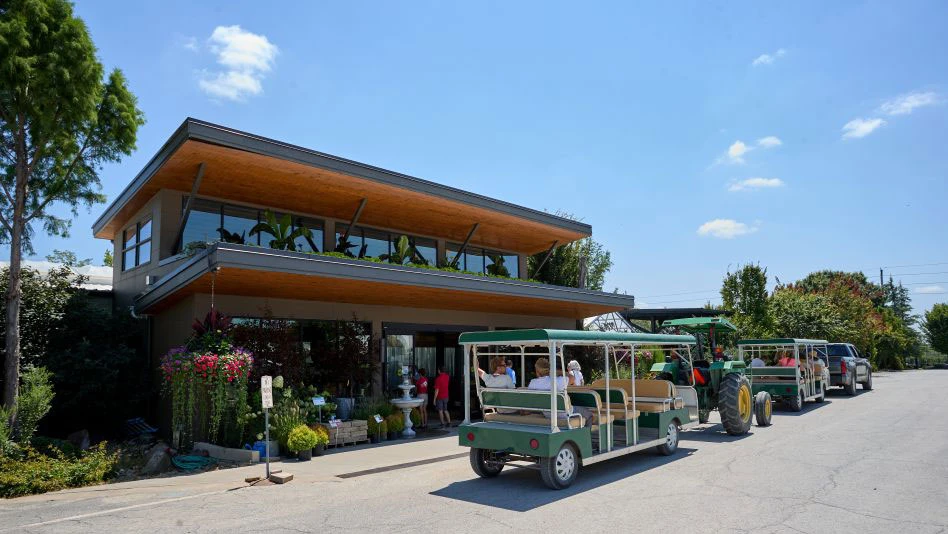
Because of the terrain at The Garden Corner, traditional shopping carts weren’t going to get the job done.
So Karsseboom took a risk and created specially designed wagons.
“They are very maneuverable. Even a small lady will be able to maneuver a cart completely loaded down with plants. I went to a cart designer and had my cart designed. It’s how you work with standard materials that makes it affordable,” he said. “There’s a lot of stuff made by the ton already. If you can use that material and put it together, it doesn’t cost that much more. It is certainly not the lowest cost, but you can make it work.”
With a prominent grower/retailer -- his father-in-law, Jack Bigej -- located nearby, Karsseboom said he has to constantly think on his feet
“Price is an easy remedy for everything,” he said. “If you want more customers you lower the price. But how do I get more customers without lowering the price? Why are people coming in? Why would they want to stop by here?”
One way he’s answered that question is by dividing up the garden center team, with one focused as garden craftsmen and the other on support.
“Garden craftsmen deal directly with customers. If the customer needs something potted up, support does the potting. They help the craftsman be able to deliver to the customer,” he said. “When the customer comes in, we know that his craftsman is Jeffery and we’ll go get him. They pick their craftsmen and then we work our list.
“In January through March, we are making sure that those top customers get help, so that they don’t get crowded in on Mother’s Day before the rush and don’t get lost with the crowd. When I’m buying, I try to keep in mind who would this be good for,” he said.
The bottom line
Karsseboom’s initial investment in the business came from his savings and an agricultural loan.
“Our growth has been rapid,” he said. “We did $300,000 the first year and now we’re up to a projected $2.5 million for 2008. We’ve been profitable since day one.”
The store’s average sale per person has steadily increased, with $121 per customer in 2007, $99 per customer sale in 2006; $73 in 2005; and $55 in 2004.
“We are examining every part of the business to see where we are doing well and where are we not,” he said. “Our scorecard is our P&L. I go over every number and there are figures we go over with staff. That needs the whole team effort.”
For more: The Garden Corner, (503) 885-1934; Jckarsseboom@aol.com.
{sidebar id=3}
- Tonie Auer
Tonie Auer is a freelance writer in
July 2008
Latest from Garden Center
- The Growth Industry Episode 10: State of the Horticulture Industry
- Scientists develop vitamin A-enriched tomato to fight global deficiency
- Tennessee Green Industry Field Day scheduled for June 11
- UTIA and UT Knoxville research teams will develop automated compost monitoring system
- Ken and Deena Altman receive American Floral Endowment Ambassador Award
- Native before it was cool
- Proven Winners partners with Pure Line Seeds to offer vegetable plants
- [WATCH] Taking root: The green industry’s guide to successful internships