DURHAM, N.H. – There’s nothing quite like the taste of a sweet, juicy New England tomato during summer. For tomato growers, picking which tomatoes appeal to New Hampshire consumers and generate strong sales can be a balancing act between those that taste good, are resistant to disease, and have a high marketable yield.
With new tomato cultivars coming out every season, scientists at the NH Agricultural Experiment Station recently conducted a three-year experiment to see how new tomato cultivars stacked up against each other after being grown in a high tunnel at the Woodman Horticultural Research Farm.
“High tunnels are increasingly being used on farms. They offer a lot of benefits to vegetable production, especially tomatoes. Our experiment looked at how different cultivars of tomatoes perform in a high-tunnel environment. There are always lots of new cultivars coming out, and high tunnels are a relatively new growing environment for tomatoes compared to in the field,” said Nick Warren, ’13, the agroecology lab manager at UNH, who conducted the tomato trial as part of his graduate research at UNH.
The research results are presented in a recent issue of the journal HortTechnology in the article “Performance of High Tunnel Cultivars in Northern New England.” In addition to Warren, the study was supervised by experiment station researchers Rebecca Sideman, extension professor of sustainable horticulture production, and Richard Smith, assistant professor of agroecology.
After consulting with different New Hampshire tomato growers, the researchers chose a number of cultivars to test. They were particularly interested disease resistance, market yield, and taste.
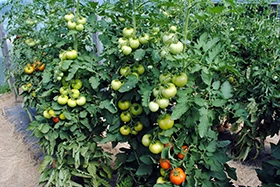
With new tomato cultivars coming out every season, scientists at the NH Agricultural Experiment Station recently conducted a three-year experiment to see how new tomato varieties stacked up against each other after being grown in a high tunnel. Photo courtesy of the University of New Hampshire.
“Our results suggest that several of the tomato cultivars examined in the study may be well suited for high-tunnel production in the northeastern United States,” Warren said. In particular, researchers found that when it comes to diseases like powdery mildew and leaf mold, the cultivars Geronimo, Massada, and Rebelski performed well all three years. Geronimo also performed well regarding marketable yield every year, with Arbason, Big Beef, Imperial 643 and Rebelski posting solid stats for two of the three years. The taste tests were inconclusive due to variability in weather, growing conditions, and individual taste preferences.
“Differences among cultivars in growth habit, disease resistance, and a host of other traits means that growers must make decisions based on their willingness to accept trade-offs in performance traits between cultivars,” Warren said. “For growers, the advantage of conducting this research at the experiment station is that we can adopt the risk of growing different cultivars because our income is not tied to it.”
Tomatoes are the most common vegetable crop grown by New Hampshire vegetable farmers, according to the USDA National Agricultural Statistics Service. Of the 682 farms growing vegetables reporting in 2012, nearly 350 said they grew tomatoes. The 2012 Agricultural Census reported that greenhouse tomatoes in New Hampshire were worth nearly $2.4 million; almost all of these were grown in heated or unheated high tunnels.
Latest from Garden Center
- The Growth Industry Episode 10: State of the Horticulture Industry
- Scientists develop vitamin A-enriched tomato to fight global deficiency
- Tennessee Green Industry Field Day scheduled for June 11
- UTIA and UT Knoxville research teams will develop automated compost monitoring system
- Ken and Deena Altman receive American Floral Endowment Ambassador Award
- Native before it was cool
- Proven Winners partners with Pure Line Seeds to offer vegetable plants
- [WATCH] Taking root: The green industry’s guide to successful internships